Lesson 3 of 8 · Lesson menu
BEGINNER LEARNING PATH
LESSON 3 OF 8
Write a clear
marketing message.
Help people understand what is available, why it matters and what to do next.
Topics in this lesson
Topic 1 · The message
What is a marketing message?
A marketing message explains what a business offers and helps the right person decide what to do next.
It answers a question.
“What can I get here?” A person should understand the product or service without having to guess.
It gives a next step.
“How do I find out more?” The message may ask someone to check details, send a message or place an order.
“Amazing quality!”
We still do not know what the business sells.
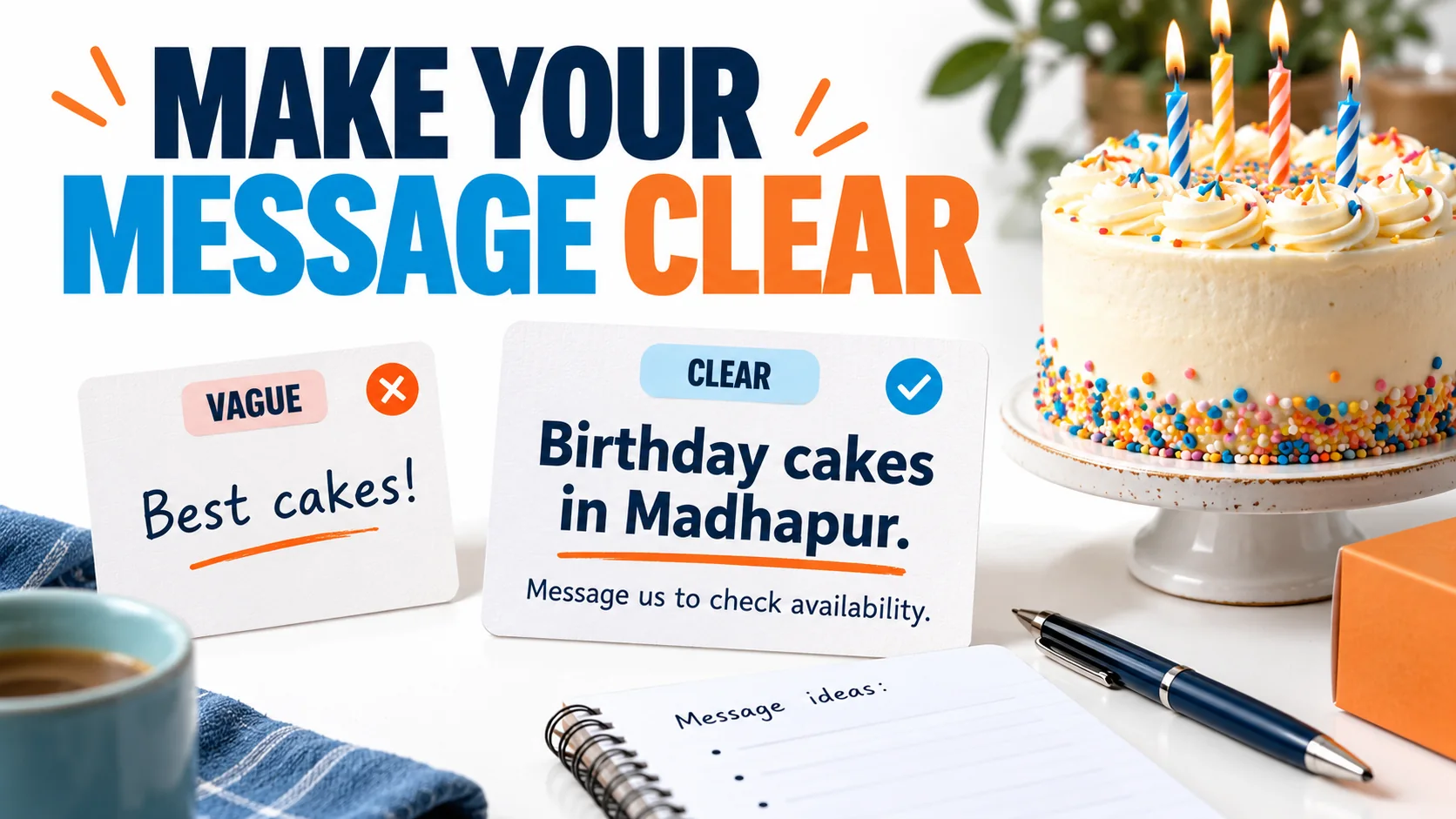
“Birthday cakes in Madhapur.”
Now we know the product and location.
A slogan can be short and memorable. A useful marketing message also gives the details a person needs.
Topic 2 · Three useful parts
Three parts that make a message useful.
One simple way to write is: say what is available, add a useful detail and explain the next step.
The offer
What does the business sell?
A useful detail
What might help the person decide?
The next step
What can the person do now?
Tap a part to see where it appears in this made-up message.
Topic 3 · Features & benefits
What is a feature? What is a benefit?
A feature is a detail about a product or service. A benefit explains how that detail may help someone.
“A cake-size guide.”
The bakery shows the available cake sizes.
“Choose a size for your gathering.”
The guide helps the buyer compare options before ordering.
“See our cake-size guide to compare sizes for your gathering.” This connects the detail with its purpose.
Describe benefits honestly. Do not turn a possible benefit into a guaranteed result.
Should every message include every detail?
No. Include the details needed for that message. A short post can link to a page with more information. Important prices, conditions or limitations should not be hidden or contradicted.
Topic 4 · Before & after
See the difference.
Clear writing uses details that matter to the customer. It does not need big words or loud promises.
Choose a made-up example.
“Best cakes! Order now!”
It makes a claim but gives little information.
“Birthday cakes in Madhapur. Ask about sizes, designs and availability. Message us with your birthday date.”
The message names the product, adds useful details and gives one clear next step.
These examples explain writing choices. They are not tested ads or promises of better sales.
Topic 5 · Common mistakes
What makes a message confusing?
People should not have to work hard to understand your offer. These small changes can make the meaning clearer.
Too many instructions“Call, follow, share, comment and buy!”
Choose the main action for this message. For example: “Message us to check cake availability.” Other actions can be explained later.
Words people do not use“Unlock premium celebration solutions.”
Use familiar words. “Birthday cakes for your celebration” is easier to understand.
Unsupported promises“Guaranteed results for everyone.”
Say what the business actually provides. Do not invent results, customer numbers, awards or guarantees.
Missing detailsAn offer with no way to ask about it
Make the next step clear. If details such as price, location or availability matter, explain them or link to the right information.
False urgency“Last chance!” when it is not
Use a deadline only when it is real. Explain the actual date or condition rather than putting pressure on people with a made-up limit.
A confusing next step“Click here” with no explanation
Tell people what they will get. “View cake sizes” is more specific than “Click here.”
Topic 6 · A clear checklist
A simple way to check a message.
Before sharing, read it as someone who knows nothing about the business.
- 1
Can they understand the offer? Name the product or service clearly.
- 2
Is the detail useful? Answer a question the customer may have.
- 3
Is it true? Check the price, availability and any claims.
- 4
Is the next step clear? Explain what the person can do.
- 5
Can it be simpler? Remove words that do not help the reader.
A clear message helps people understand an offer. It does not guarantee enquiries or sales.
Optional: try this after you understand the lesson.
Choose one product from a shop you know. Write what it is, one true useful detail and one next step. Read it aloud. You do not need to publish it.