
Lesson 1 of 8 · Lesson menu
BEGINNER LEARNING PATH
LESSON 1 OF 8
Digital marketing,
made easy.
Understand the basics before you try anything. Short explanations. Everyday examples. One topic at a time.
Topics in this lesson
Topic 1 · What it means
What is digital marketing?
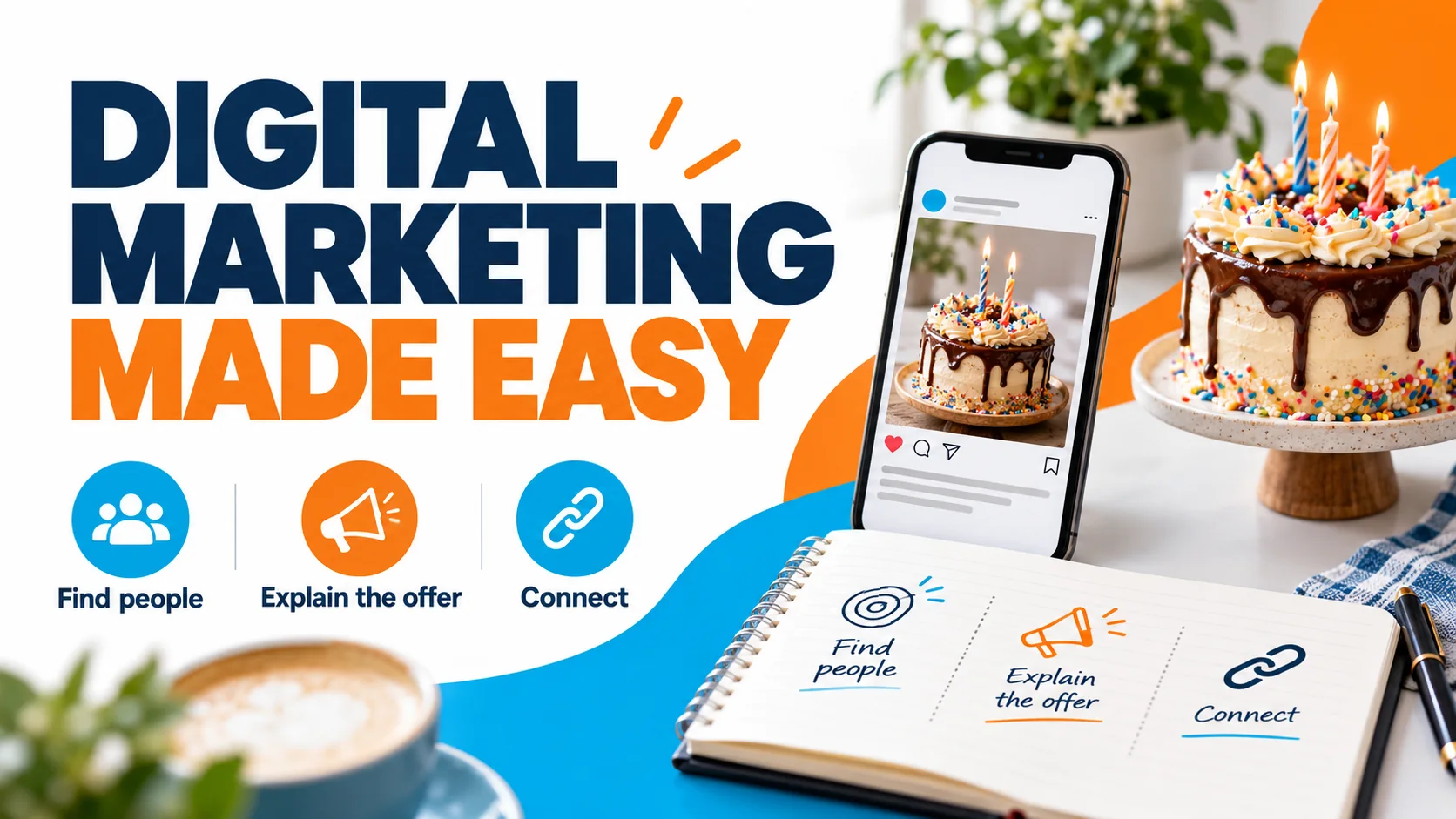
Digital marketing means using the internet to help people find a business, understand what it offers and take the next step.
Find the business
Someone sees a post, an ad or a Google result.
Understand the offer
They learn what is available and whether it suits them.
Take the next step
They ask a question, visit the shop or place an order.
A bakery shares a cake photo on Instagram. A parent sees it and messages the bakery to ask about the price. That is one example of digital marketing.
Posting is only one part. The message, the people you reach and the next step also matter.
Topic 2 · How it works
How does it work?
People usually need more than one reason to buy. They may notice a business, learn about it and ask questions before deciding.
This is called a customer journey. Tap a stage to see the bakery example.
People can skip steps, return later or choose another business. This is a simple example, not a fixed path.
Topic 3 · The main parts
What are the main parts?
Different parts do different jobs. A website explains. A post gets attention. A message can answer a question.
Open a card to understand each one.
WebsiteA place to explain your business
A website is a set of pages people can visit online. It can show your products, services, prices and contact details. Example: a bakery page showing cake sizes.
SEOHelp people find useful pages
SEO means improving a website so search engines can understand it and people can find it. It stands for search engine optimisation. It does not guarantee first place on Google.
Social mediaShare posts and videos
Platforms such as Instagram and Facebook let a business share updates and speak with people. Example: a video showing how a cake is decorated.
Paid adsPay to show a message
A business pays a platform to show an ad. Google Ads and Meta Ads are examples. Paying for views or clicks does not guarantee orders.
ContentThe information you share
Content includes words, photos and videos. It helps people understand something. Example: a short video explaining how to choose the right cake size.
Email & WhatsAppShare updates and answer questions
These can help a business speak with interested people. Ask permission before sending marketing messages. Do not send promotions to random people.
A business does not need to use everything at once. The right choice depends on its customers and goal.
Topic 4 · Useful words
Three words you will hear often.
You do not need to memorise difficult words. Understand what they mean in a real situation.
Audience
The group of people a business wants to reach.
Bakery example: nearby parents planning a birthday.
Lead
A person who shows interest in a product or service.
Bakery example: someone asks about a cake’s price.
Conversion
A chosen action that a business counts.
Bakery example: a confirmed order, if orders are the action being measured.
Can an enquiry also be a conversion?
Yes, if the business chooses to count enquiries as its goal. Another report may count orders. Always check which action the number refers to. An enquiry is not automatically a sale.
Topic 5 · Reading results
How do we know what worked?
Analytics means looking at numbers to understand what happened. Start with the result that matters to the business.
Likes are reactions.
A like shows that someone reacted to a post. It does not tell us whether they bought.
Orders are purchases.
Keep records of enquiries and confirmed orders separately.
What percentage of these enquiries became orders?
2 ÷ 10 × 100 = 20%. This is a made-up example to explain the calculation. It is not a target or a typical business result.
A few numbers cannot explain everything. Prices, season, availability and other factors may also affect orders. If you do not know where an enquiry came from, do not guess.
Topic 6 · What to learn
What should you learn first?
Learn the idea first. Then see an example. Practise only when the idea is clear.
- 1
Understand the customer. Who needs the product, and why?
- 2
Learn to explain the offer. What is available? Why might it help?
- 3
Understand websites and content. Where will people get the details?
- 4
Learn one way to reach people. Start with SEO or social media. Learn ads after you understand budgets and measurement.
- 5
Learn to read results. Separate views, questions and orders.
Optional: try a small example when you are ready.
Choose a local shop. Write who its customer is, what it offers and one question a customer may ask. This is only practice. You do not need to run an ad or publish anything.
It is fine to read a topic again. Understanding is more useful than rushing.