Practical projects matter in a digital marketing course because employers hire people who can show work, not people who can describe it. Live campaigns teach judgement that no lecture can: what to do when results drop, what to cut, and what to tell a client. A course without real projects produces graduates who understand marketing but cannot yet do it.
Important note: “practical” appears in almost every course brochure. The word is worthless on its own, so the questions in section 6 matter more than the claim.
- 1. Why do practical projects matter more than the syllabus?
- 2. What can you learn only from a live project?
- 3. What does a real practical project actually look like?
- 4. How do employers judge project work in an interview?
- 5. What do people get wrong about projects and certificates?
- 6. How do you check if a course really includes live projects?
Why Do Practical Projects Matter More Than the Syllabus?
Practical projects matter more than the syllabus because every institute teaches roughly the same topics, and none of that content is scarce. What separates one graduate from another is whether they have run something real and can explain what happened. The syllabus is the menu; the project is the meal.
Search for any digital marketing topic and you will find free tutorials covering it properly. Information has no value on its own anymore.
What still has value is judgement, and judgement only forms when you make a decision, watch the result, and live with the consequence.
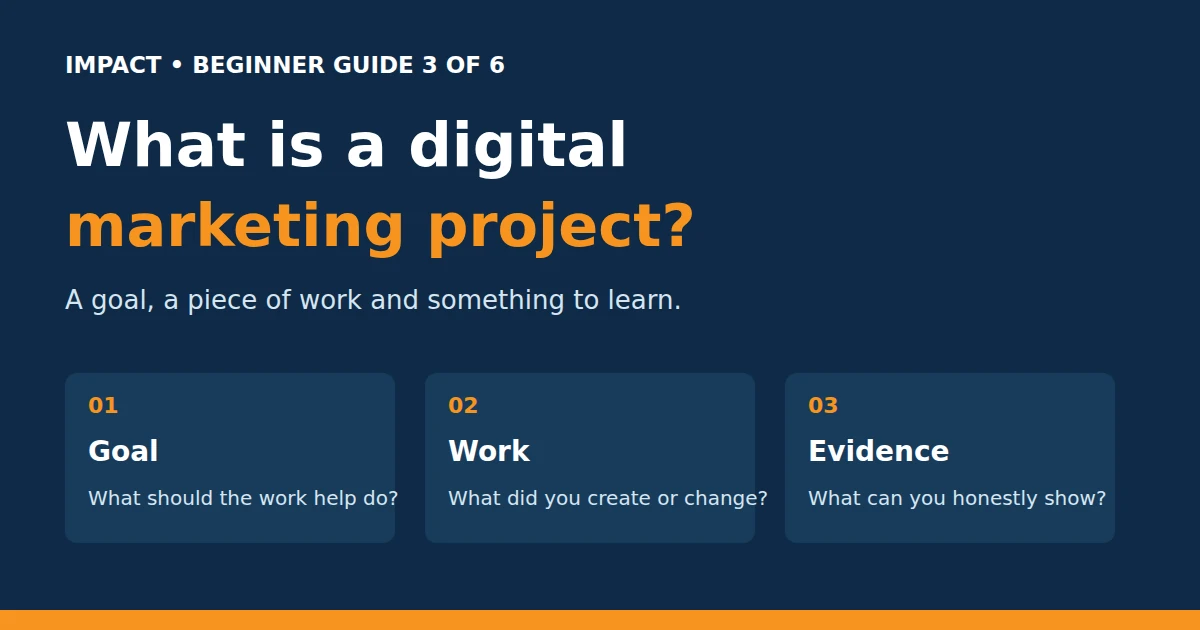
A practical project in digital marketing training is live work on a real website, ad account, or social page where the traffic, budget, and results are genuine rather than simulated.
| Situation | Theory-only training | Project-based training |
|---|---|---|
| You are asked “how would you fix falling traffic?” | Lists possible causes | Describes what they actually checked first, and why |
| A campaign underperforms | Knows the metrics involved | Has already sat with a bad result and worked through it |
| Portfolio at interview | Certificate and notes | Dated screenshots of before and after |
| First week on the job | Needs the process explained again | Recognises the dashboard immediately |
Both learners studied the same syllabus. Only one of them has anything to talk about.
What Can You Learn Only From a Live Project?
Live projects teach four things no classroom can deliver: how to decide with incomplete data, how to handle a result you did not expect, how long real progress takes, and how to explain your work to someone who is paying for it. These are the exact abilities interviews test.
The four lessons that need real stakes
- Deciding without certainty. Real accounts never give you the clean case-study data used in lectures, so you learn to act on partial evidence.
- Sitting with a bad result. When your change makes numbers worse, you learn diagnosis. A dummy assignment cannot fail, so it teaches nothing here.
- Understanding real timelines. SEO taking four months is an abstract fact until you watch four months pass on a page you wrote.
- Explaining your reasoning. Talking through a decision out loud is a separate skill from making it, and it is the one interviews measure most.
In our batches at Impact Digital Marketing Institute, the moment a learner genuinely changes is not when they finish a module. It is the first time a campaign they built underperforms and they have to work out why. At Pixel Ranks Media Agency we have interviewed candidates from many institutes, and the difference is obvious within five minutes: theory-trained candidates answer with lists, project-trained candidates answer with a story about a specific decision. Learners who only complete assignments hit that wall on the job instead, where the cost of being lost is much higher. — Rakesh Bandari
What Does a Real Practical Project Actually Look Like?
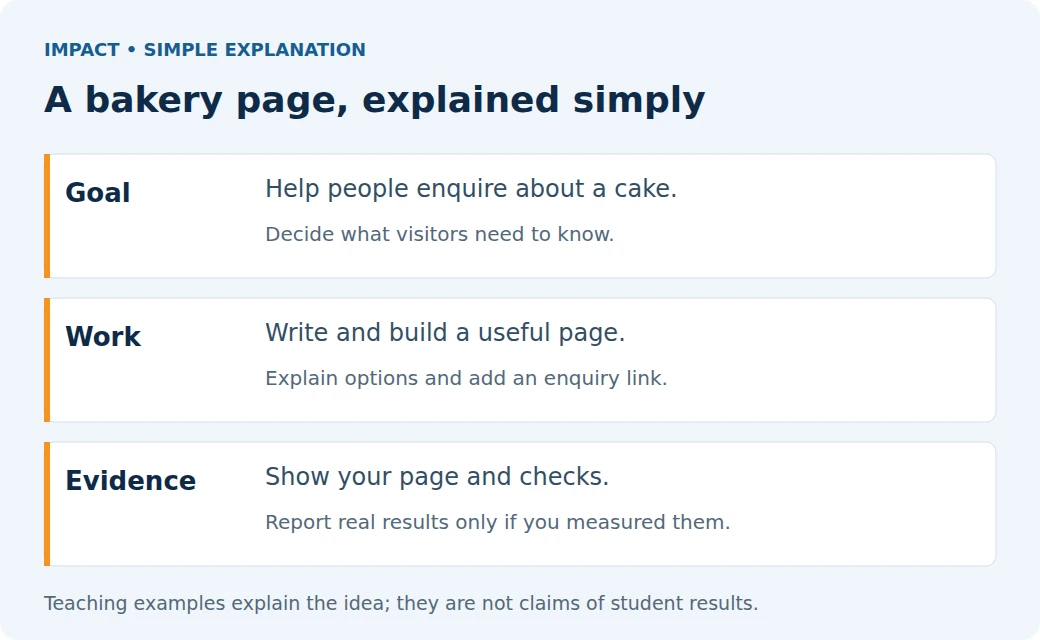
A real practical project has a live URL or ad account, measurable data you can open, a decision you personally made, and a result you can point to. If any of those four is missing, it is an exercise rather than a project.
A learner is given a small local business page targeting three service keywords. Over eight weeks she rewrites the service page, fixes the title structure, and builds two supporting blog posts. Search Console shows the main keyword moving from position 34 to position 11 and clicks rising from 6 to 41 per month. In interviews she opens that screenshot and explains why she prioritised the service page first. That conversation is worth more than her certificate.
Tools such as Search Console, GA4 and Ahrefs matter here mainly because they produce the evidence. Learning the interface is easy; having data of your own to read inside it is the part most learners never reach. Our guide on how to build real experience while learning covers this in more depth.
How Do Employers Judge Project Work in an Interview?
Employers test reasoning, not results. They ask what you tried, why you chose it, what happened, and what you would do differently. A modest project explained clearly beats an impressive one you cannot account for.
This surprises most candidates. They assume the numbers are being judged, so they hide the projects that went badly.
Those are usually the most useful ones to discuss, because a hiring manager learns more from how you handled a problem than from a screenshot of a good month.
Presenting projects as a list of tasks completed. Saying “I did on-page SEO, keyword research and content writing” tells an employer nothing, because it describes activity rather than thinking. Say instead: “The service page was targeting five keywords at once, so I split it into two pages and clicks doubled in six weeks.” One sentence, one decision, one outcome.
The four questions to prepare for every project
- What was the problem? State it in one sentence with a number attached.
- What did you change, and why that first? Prioritisation is the skill being tested.
- What happened? Give the honest result, including the ones that disappointed you.
- What would you do differently? This answer separates a learner from a beginner.
Keeping a short written record of each project also gives you something to put on LinkedIn while you are still studying, which is how many first interviews actually arrive.
Check If Digital Marketing Matches Your Skills and Interests
Project-based learning suits people who enjoy testing, measuring and adjusting. The free assessment shows whether that matches how you like to work, before you commit to any course.
What Do People Get Wrong About Projects and Certificates?
Three beliefs cost students the most: that a certificate proves capability, that a detailed syllabus signals quality, and that projects can wait until after the course. Each one sounds reasonable and each one delays employability by months.
This pattern explains a lot about why many students do not get jobs after a digital marketing course, and it is closely related to why companies hesitate to hire certified freshers. The certificate was never the problem. The empty portfolio behind it was.
How Do You Check if a Course Really Includes Live Projects?
Ask specific questions before enrolling, because every brochure claims practical training. The useful questions are about ownership, budget and access: whose account you will work on, whether real money is spent, and what you keep at the end.
The last two matter most. Feedback is the difference between practice and repetition, and a portfolio you own is the only part of a course that keeps working for you afterwards.
Vague answers here are informative. An institute running genuine live projects can name the accounts, the tools and the review process without hesitation.
At Impact Digital Marketing Institute, learners work on live assets rather than dummy files for exactly this reason, and the full list of questions to ask before joining any course is worth reading before you visit anywhere. It pairs well with why the syllabus matters less than you think.
Choose a digital marketing course by the work you will produce inside it, not the topics listed in the brochure — the portfolio is the only part you keep.
- Practical projects matter in a digital marketing course because hiring decisions are based on demonstrated work, not completed modules.
- Live projects teach diagnosis, timelines and explanation, which simulated assignments cannot.
- Before enrolling, ask whose live account you will work on and what portfolio you keep afterwards.
Not Sure If Digital Marketing Is Right for You?
Project-based training rewards people who enjoy building things and reading results. The Impact Digital Marketing Career Assessment looks at your career fit, learning readiness, analytical and creative strengths, communication style and motivation, then suggests a path that matches. It takes about three minutes and exists to help you decide, not to push you into a course.
Take The Career AssessmentFrequently Asked Questions
Why are practical projects important in a digital marketing course?
Short answer: Because employers hire based on work you can show, not topics you have studied.
Projects produce screenshots, decisions and outcomes you can discuss in an interview. Theory alone leaves you able to define terms but unable to describe anything you have actually run.
How many projects should a digital marketing course include?
Short answer: At least one live project per learner, ideally two or three across different channels.
Quantity matters less than authenticity. One genuine live asset with real data teaches more than six simulated case studies with predetermined answers.
What is the difference between a live project and a dummy assignment?
Short answer: A live project has real traffic or real budget; a dummy assignment does not.
Dummy work cannot fail, so it never teaches diagnosis. Live work produces unpredictable results, which is exactly the experience employers are testing for in interviews.
Can I do practical projects on my own without an institute?
Short answer: Yes, though progress is slower without feedback.
Starting a blog or managing a small business page gives you real data. What self-learning lacks is someone experienced telling you which of your decisions was wrong and why.
Do employers actually ask to see project work?
Short answer: Yes, and it usually comes up within the first ten minutes.
Most interviews move quickly from qualifications to “what have you worked on”. Candidates with dated screenshots and a clear explanation move forward far more often than candidates with certificates alone.
What if my practical project did not get good results?
Short answer: Present it anyway, focusing on your reasoning.
Interviewers assess judgement, not outcomes. Explaining what you tried, what happened and what you would change demonstrates more capability than a lucky result you cannot account for.
Is a certificate useless without projects?
Short answer: Not useless, but it will not get you hired on its own.
A certificate helps you pass initial screening and shows commitment. It stops being relevant the moment the conversation turns to what you can do, which is where the portfolio takes over.
How long does it take to build a usable project portfolio?
Short answer: About 8 to 12 weeks of consistent work on one live asset.
That window is long enough for search or campaign data to show a trend. Anything shorter rarely produces the before-and-after comparison that makes a portfolio persuasive.
Recommended Next Steps
- Practical projects matter because employers hire on demonstrated work, not completed course modules.
- Live projects teach diagnosis, real timelines and client explanation that theory cannot.
- A genuine project has a live link, real data, your own decision and a measurable result.
- Before enrolling, ask whose live account you will work on and what portfolio you keep.
Related Articles
- Interview and hiring observations, Pixel Ranks Media Agency, 2024–2026.
- Learner portfolio outcomes and batch observations, Impact Digital Marketing Institute, 2024–2026.
- Portfolio timeline estimates based on Search Console data ranges from learner projects.
Discover Your Digital Marketing Career Potential
Before choosing any course, find out whether this work suits you. Three minutes, free, and the report is yours immediately.
Start My Assessment