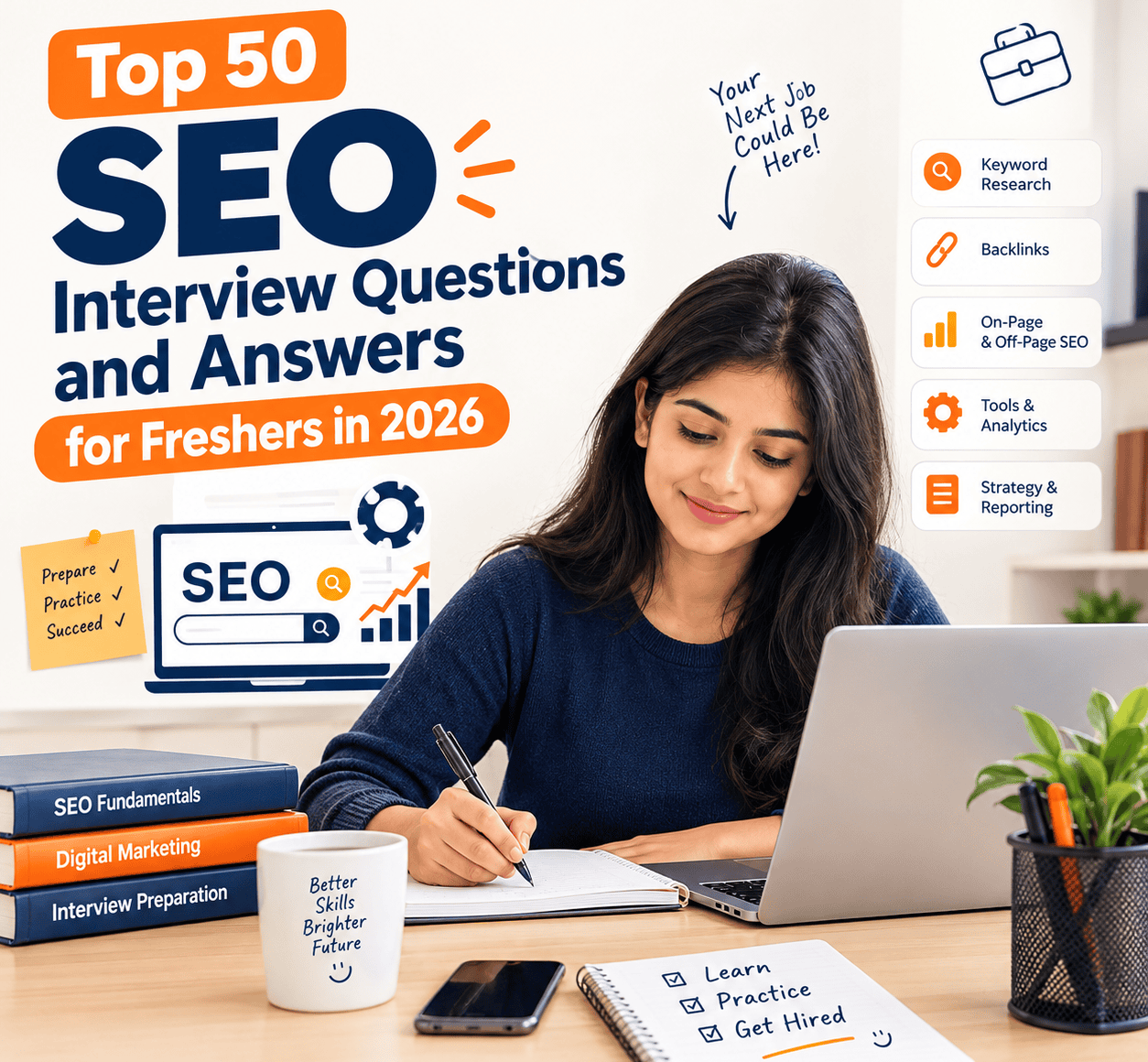
The top 50 SEO interview questions and answers for freshers in 2026 fall into six groups: basics, on-page, technical, off-page, tools and analytics, and AI search. Interviewers want a clear definition, one real example and honest limits of what you know. Prepare each group and you can handle almost any fresher SEO round.
What are the most common SEO interview questions and answers for freshers on the basics?
The most common SEO interview questions for freshers test whether you can define search engine optimization (SEO), explain how Google finds and ranks pages, and separate close terms such as crawling and indexing. At Impact Digital Marketing Institute, I tell every batch that a one-sentence definition followed by one real example beats a long textbook answer.
1. What is SEO?
SEO is the practice of improving a website so search engines can find it, understand it and show it higher for relevant searches. The goal is more qualified organic visitors without paying for each click. For a deeper primer, read our guide on what SEO is in digital marketing.
2. What are the main types of SEO?
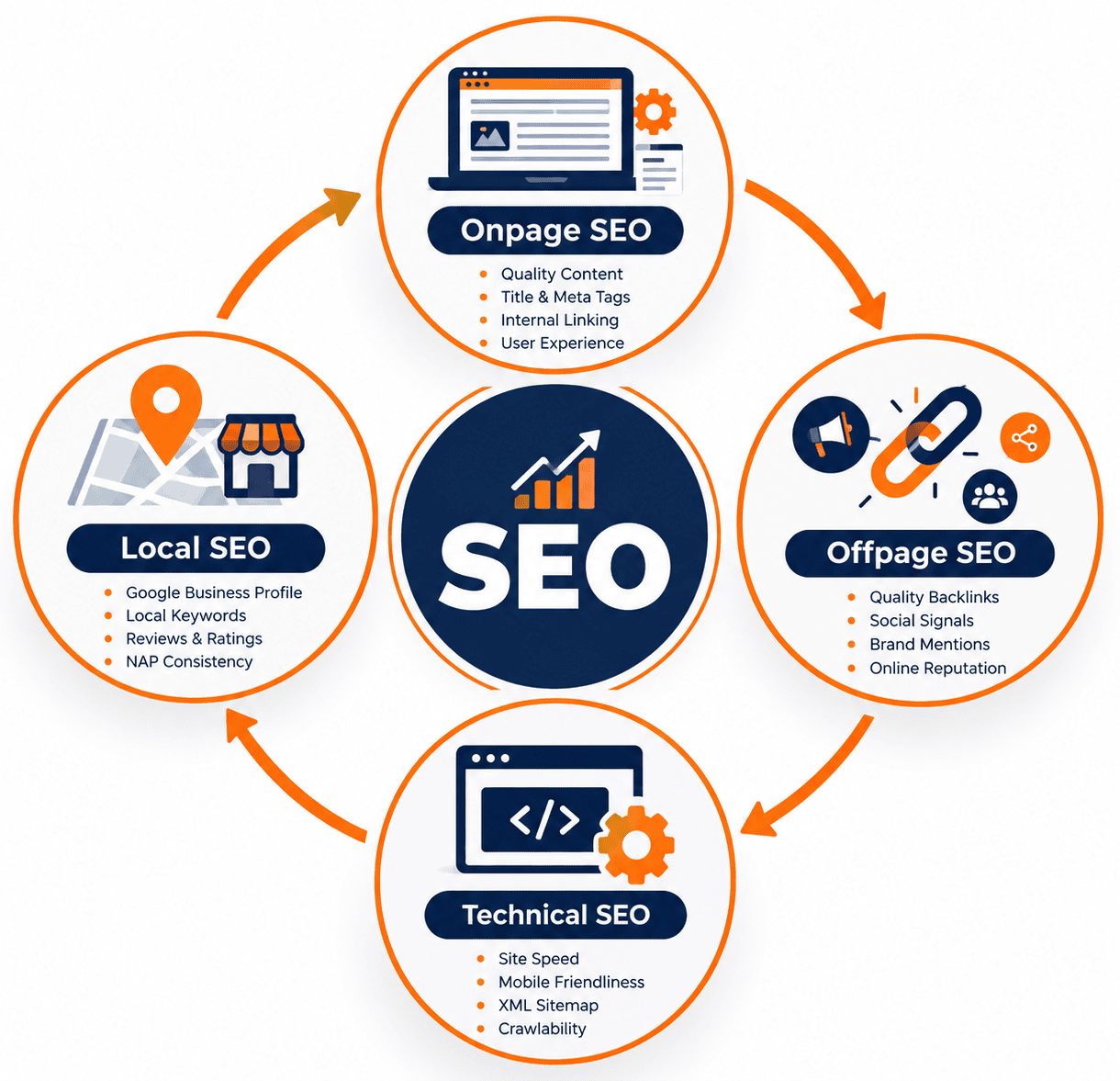
The main types are on-page SEO (content and HTML), off-page SEO (links and brand signals), technical SEO (crawling, speed and structure) and local SEO (map and city searches). Name all four, then say which one you practised most.
3. What is the difference between organic and paid results?
Organic results earn their position through relevance and authority, so clicks cost nothing. Paid results are ads where the advertiser pays per click. Organic builds slowly and lasts longer, while paid starts instantly and stops when the budget stops.
4. What is a SERP?
A SERP, or search engine results page, is the page Google shows after a search. It can hold ads, featured snippets, local maps, image packs, People Also Ask boxes and AI summaries alongside the ten blue links.
5. What is a keyword, and what are the types?
A keyword is the word or phrase a person types into a search engine. Short-tail keywords are broad, like “seo”, while long-tail keywords are specific, like “seo interview questions for freshers”. Long-tail terms usually convert better because intent is clearer.
6. What is search intent?
Search intent is the reason behind a search. The four common types are informational (learn), navigational (find a site), commercial (compare) and transactional (buy). A page that ignores intent will not rank, however well optimised it looks.
7. What is a crawler, and what is Googlebot?
A crawler is a program that visits web pages by following links. Googlebot is Google’s crawler. It downloads pages so Google can process them, which is why blocked or broken pages never get a chance to rank.
8. What is the difference between crawling and indexing?
Crawling means a bot visits a page. Indexing means Google stores and understands that page so it can appear in results. A page can be crawled but not indexed if the content is thin, duplicate or marked noindex.
9. What are white hat, black hat and grey hat SEO?
White hat follows search engine guidelines, black hat breaks them through tricks like cloaking or paid link schemes, and grey hat sits in between. Say you only recommend white hat methods, because black hat risks penalties.
10. What is E-E-A-T?
E-E-A-T stands for Experience, Expertise, Authoritativeness and Trustworthiness. It is a quality framework Google’s reviewers use to judge content. Show it with real author names, first-hand examples, sources and clear contact details.
Which on-page SEO interview questions should freshers prepare?
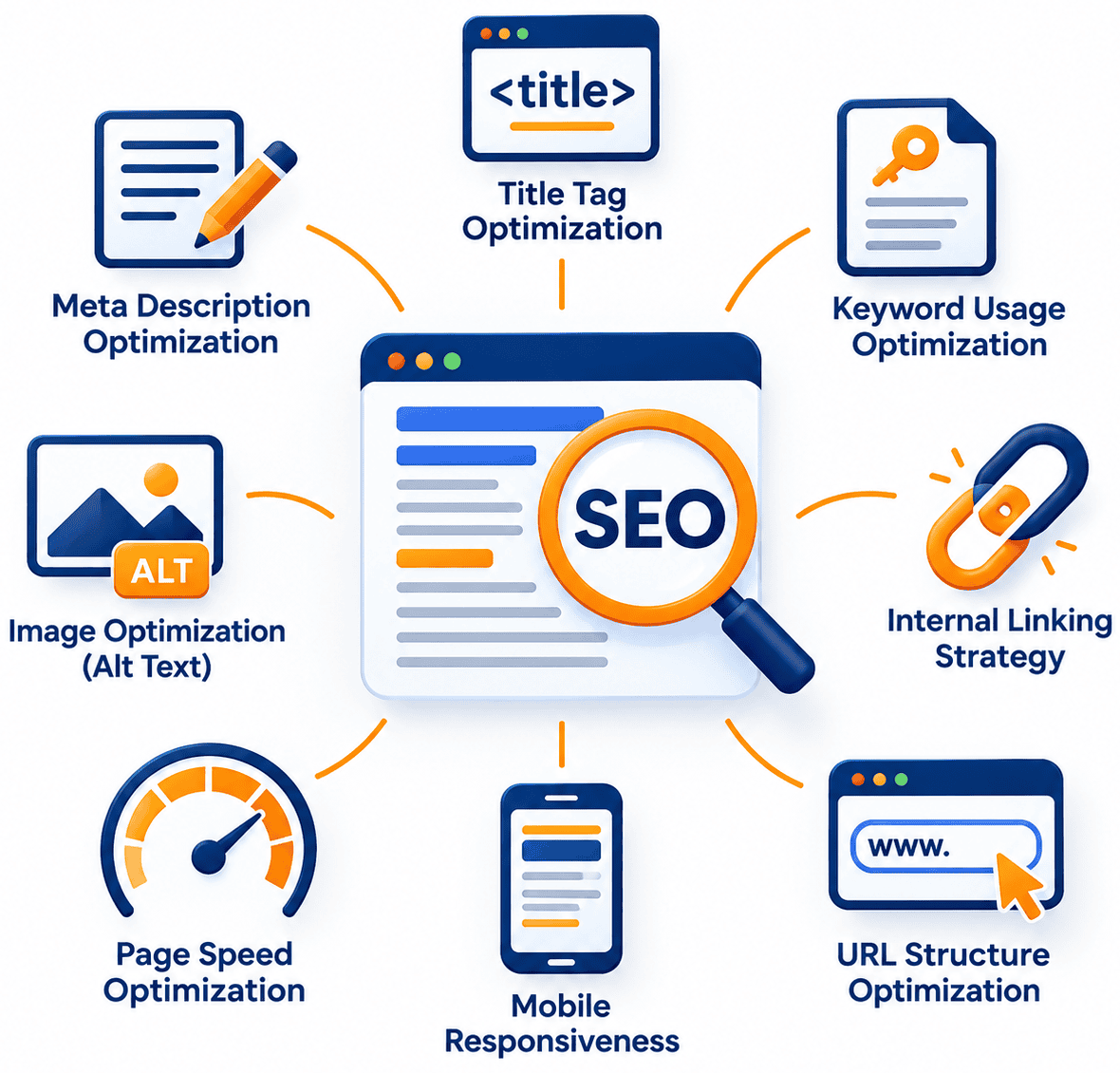
On-page SEO interview questions cover the elements you control directly on a page: titles, meta descriptions, headings, content, images, URLs and internal links. Expect at least three of these in every fresher round. Our on-page SEO checklist mirrors the points interviewers check, and students at Impact Digital Marketing Institute practise them on live pages.
11. What is on-page SEO?
On-page SEO is the optimisation of elements inside a page, such as the title tag, headings, content, images and internal links, so search engines and readers understand its topic quickly.
12. What is the ideal title tag length?
Aim for roughly 50 to 60 characters so the title does not get cut off in results. In practice Google truncates by pixel width, not characters, so wide letters shorten the limit. Put the main keyword near the start.
13. Is the meta description a ranking factor?
No, the meta description is not a direct ranking factor. It still matters because a clear, benefit-led description improves click-through rate, and more clicks on a result can support its performance.
14. How should heading tags be structured?
Use one H1 for the page topic, then H2s for main sections and H3s for sub-points. Never skip levels. Headings are a content outline first and a keyword spot second.
15. What is keyword density, and what is the right percentage?
Keyword density is how often a keyword appears compared with total words. No magic percentage exists, though a natural range near 1% is a safe guide. Candidates who insist on “2%” signal outdated learning.
16. What is keyword cannibalization?
Keyword cannibalization happens when two or more pages on one site target the same query, so they compete against each other. Fix it by merging pages, redirecting the weaker one or re-targeting it to a different intent.
17. What is internal linking, and why does it matter?
Internal linking connects pages within the same site using descriptive anchor text. It helps crawlers discover pages, spreads authority across the site and guides readers to related answers.
18. How do you optimise images for SEO?
Compress files, use descriptive filenames, write accurate alt text and set width and height to avoid layout shifts. Alt text should describe the image for a visually impaired reader, not repeat the keyword.
19. What makes a URL SEO-friendly?
A good URL is short, readable, lowercase, hyphen-separated and contains the main topic, such as /seo-interview-questions/. Avoid dates, session IDs and long parameter strings.
20. What is thin content?
Thin content is a page with little original value, such as copied text, doorway pages or near-empty articles. Google may skip indexing it. The fix is adding original insight, examples or data, not just more words.
What technical SEO interview questions do freshers get asked?
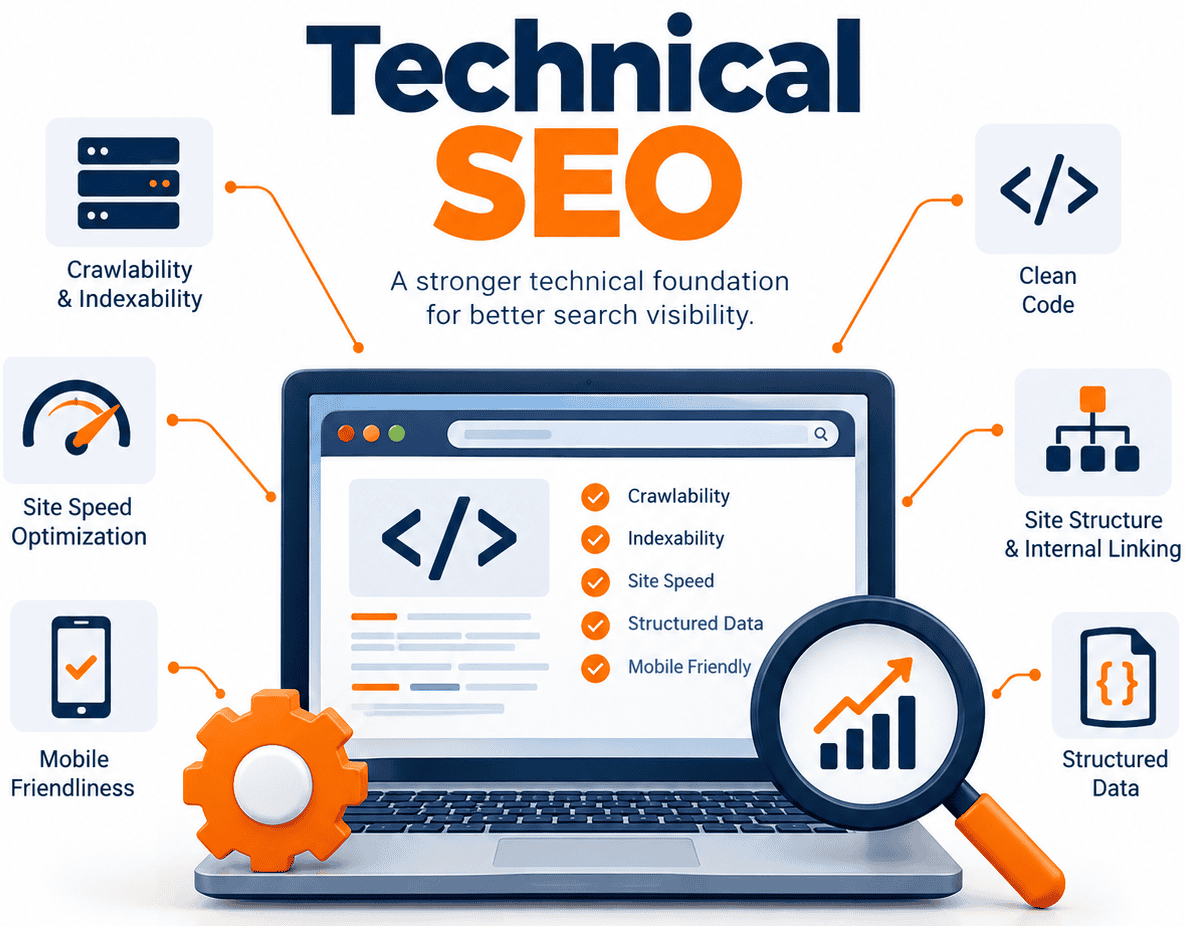
Technical SEO interview questions check whether you understand how search engines crawl, render and index a website. Freshers are rarely expected to code, but they must explain robots.txt, sitemaps, canonical tags, redirects, Core Web Vitals and schema in plain words and say when each one matters.
21. What is technical SEO?
Technical SEO is the work that helps search engines crawl and index a site efficiently. It covers site speed, mobile usability, structured data, redirects, sitemaps and clean architecture.
22. What is robots.txt?
Robots.txt is a text file at the site root that tells crawlers which paths they may or may not visit. It controls crawling, not indexing, so a blocked URL can still appear in results if other sites link to it.
23. What is an XML sitemap?
An XML sitemap is a file listing the URLs you want search engines to discover. It helps new or deeply buried pages get found, and you submit it through Google Search Console.
24. What is a canonical tag?
A canonical tag is an HTML element that names the preferred version of a page when similar versions exist. It consolidates ranking signals onto one URL. Canonical is a hint, while a 301 redirect is an instruction.
25. What is the difference between a 301 and a 302 redirect?
A 301 is a permanent redirect that passes ranking signals to the new URL. A 302 is temporary, telling search engines the original URL will return. Use 301 for permanent moves such as URL changes or site migrations.
26. What is a 404 error, and what is a soft 404?
A 404 means the server says the page does not exist. A soft 404 shows a “not found” message but returns a 200 status, which confuses crawlers. Return proper 404 or 410 codes for removed pages.
27. What are Core Web Vitals?
Core Web Vitals are Google’s page experience metrics: Largest Contentful Paint (loading speed), Interaction to Next Paint (responsiveness) and Cumulative Layout Shift (visual stability). Good scores improve user experience and act as a ranking signal.
28. What is mobile-first indexing?
Mobile-first indexing means Google primarily uses the mobile version of a page to index and rank it. If your mobile page hides content that the desktop page shows, that content may not count.
29. What is schema markup?
Schema markup is structured data added to a page so search engines understand its meaning, such as articles, FAQs, products or reviews. It can unlock rich results, though it does not guarantee higher rankings.
30. What is crawl budget?
Crawl budget is the number of pages Googlebot will crawl on a site in a given period. It matters mainly for very large sites. Wasting it on duplicate or parameter URLs delays discovery of important pages.
In our batches, the most common confusion is canonical versus 301 versus noindex. At Pixel Ranks Media Agency, we hand freshers a page with two duplicate URLs and ask them to pick the fix. Candidates who explain why they chose one, not just name it, get the offer. — Rakesh Bandari, Impact Digital Marketing Institute
How are off-page SEO and link building questions asked in interviews?
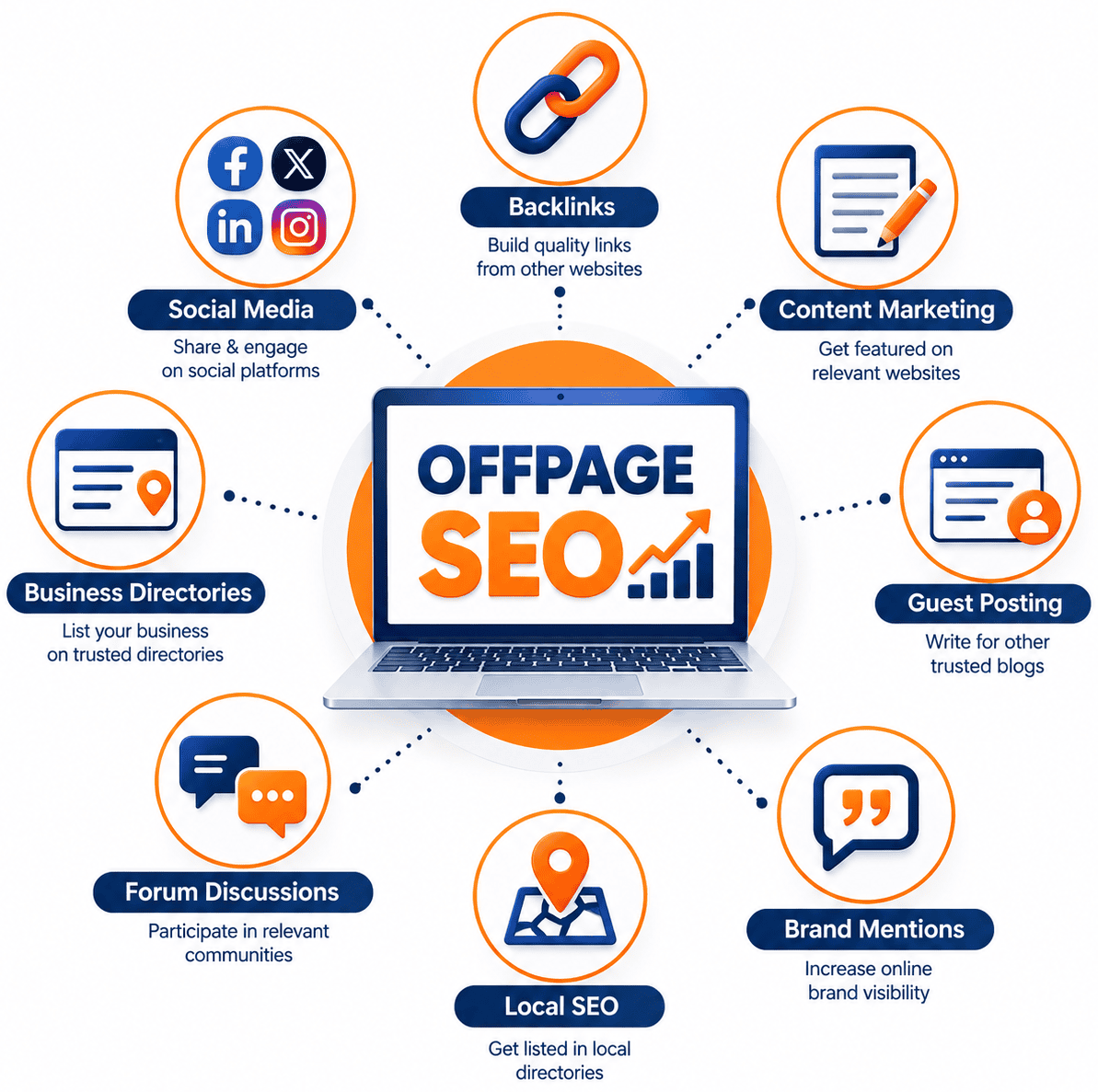
Off-page SEO questions ask how a site earns trust outside its own pages, mainly through backlinks, brand mentions and local citations. Interviewers want to know you understand link quality over quantity, can spot risky tactics and can name safe methods. Our guide to the types of backlinks in SEO covers the detail.
31. What is off-page SEO?
Off-page SEO covers actions outside your website that build authority and trust, including backlinks, brand mentions, digital PR, social signals and local citations.
32. What is a backlink?
A backlink is a link from another website to yours. Search engines treat quality links as votes of trust, so a link from a respected, relevant site carries far more weight than many from weak ones.
33. What is the difference between dofollow and nofollow links?
A dofollow link passes ranking signals, while a nofollow link tells search engines not to pass them. Google treats nofollow, sponsored and UGC attributes as hints. A natural profile contains a healthy mix of all.
34. What makes a backlink high quality?
A strong backlink comes from a relevant, trusted, indexed site, sits inside editorial content and uses natural anchor text. One relevant link from an industry publication outweighs fifty directory links.
35. What is anchor text, and what types exist?
Anchor text is the clickable text of a link. Types include exact match, partial match, branded, generic (“click here”) and naked URL. Over-using exact match looks manipulative and risks a penalty.
36. What are toxic backlinks, and what is disavow?
Toxic backlinks come from spammy or manipulative sites. The disavow tool tells Google to ignore specific links. Use it only for a clear link-spam problem, because Google already ignores most low-quality links on its own.
37. What are safe link building methods?
Safe methods include guest posting on relevant sites, digital PR, original research, broken link building and creating resources others want to cite. Avoid buying links or joining link exchange schemes.
38. What is local SEO, and what is NAP?
Local SEO helps a business appear in map and “near me” searches. NAP means Name, Address, Phone number, which must stay identical across listings. Read our local SEO guide for 2026 for the full workflow.
Check If Digital Marketing Matches Your Skills and Interests
Interview prep works best when you know the career suits you. Take the free assessment before you invest more time.
Which SEO tools and analytics questions come up in fresher interviews?
Fresher interviews ask which SEO tools you have used and how you read their data. Interviewers care less about the tool list and more about whether you can open Google Search Console or Google Analytics 4 and explain what a report means. Impact Digital Marketing Institute students practise this on real sites.
39. What is Google Search Console?
Google Search Console is a free Google tool that shows how a site performs in search: queries, clicks, impressions, indexing status and errors. See how it works in our Google Search Console guide.
40. What is the difference between Search Console and GA4?
Search Console shows what happens before the click, such as impressions and rankings. Google Analytics 4 shows what happens after, such as sessions, engagement and conversions. Strong SEOs read both together.
41. Which SEO tools have you used?
Name tools you have truly opened, such as Search Console, Rank Math, Screaming Frog, Semrush or Ahrefs. Then describe one task you completed with each. Listing ten tools you cannot demonstrate backfires quickly.
42. How do you do keyword research?
Start with seed topics, expand them with a keyword tool, check search intent in the live results, then pick terms by relevance, volume and difficulty. Our guide on keyword research like a pro walks through each step.
43. Which SEO metrics do you track?
Track organic clicks, impressions, average position, click-through rate, indexed pages, organic conversions and Core Web Vitals. Rankings alone prove little, while organic conversions prove business value.
44. What is engagement rate in GA4?
Engagement rate in GA4 is the share of sessions that lasted over 10 seconds, had a conversion event or included two or more page views. It replaced bounce rate as the main interaction measure.
What AI search and scenario questions are asked in 2026 SEO interviews?
In 2026, SEO interviews add questions on answer engine optimization (AEO), generative engine optimization (GEO), AI tools and live problem-solving scenarios. Interviewers want to see whether you can adapt to AI-driven search and diagnose problems calmly. Our AEO and GEO guide explains the basics.
45. What are AEO and GEO?
AEO optimises content to be chosen as a direct answer in featured snippets and voice results. GEO optimises content to be cited inside AI-generated answers. Both reward clear definitions, structured sections and verifiable facts.
46. Will AI replace SEO?
No. AI changes how results appear, but websites still need to be found, trusted and cited. SEO is shifting toward clear answers, original insight and entity trust. The role is evolving, not disappearing.
47. How would you use AI tools in SEO safely?
Use AI for research, outlines, clustering and drafts, then add real experience, fact-check every claim and edit for brand voice. Publishing raw AI output risks thin, generic content that adds nothing new.
48. Organic traffic dropped sharply overnight. What do you do?
First confirm the drop in Search Console and GA4, then check for tracking errors, indexing changes, robots.txt or noindex mistakes, recent site changes and Google update dates. Fix technical causes first before rewriting content.
A fresher is told a 40-page blog lost about 30% of clicks in one week. She checks Search Console, finds the drop started on the day a developer pushed a theme update, and discovers the new template added a noindex tag to blog posts. She removes the tag, requests reindexing and monitors recovery over the next two weeks.
49. A new page is not ranking after two months. What do you check?
Check whether the page is indexed, then whether it matches search intent, has internal links pointing to it and offers more value than the current top results. Weak intent match is the most common cause.
50. What is a Google core update, and how do you respond?
A core update is a broad Google change to how it assesses content quality. Do not panic-edit. Compare affected pages against ranking competitors and improve helpfulness. See our list of Google algorithm updates for context.
How should freshers prepare for an SEO interview in 2026?
Prepare for an SEO interview in 2026 by learning these 50 questions in groups, practising answers aloud and applying each concept to a real website. At Impact Digital Marketing Institute, candidates who can show one optimised page outperform those who recite perfect definitions. Seven to ten focused days is enough.
Memorising definitions without a single live example. It happens because most online lists reward recall. Avoid it by attaching one page you actually changed to every major answer, and be ready to show it.
Real practice matters more than certificates, a point we explain in what skills actually matter for getting hired.
- These top 50 SEO interview questions for freshers in 2026 span basics, on-page, technical, off-page, tools and AI search.
- Interviewers reward short definitions, real examples and a calm diagnosis process.
- Practise on a live site, because shown work beats recited answers.
Frequently asked questions
How many SEO interview questions should a fresher prepare?
Short answer: Prepare around 40 to 50 core questions across six topic groups.
Coverage matters more than count. Make sure each group, from basics to AI search, has at least five answers you can explain with one example.
How long does it take to prepare for an SEO interview?
Short answer: Most freshers need seven to ten days of focused practice.
Spend about one hour daily: half on answers, half on a real website in Search Console. Learners with no background may need two to three weeks.
Do SEO interviews include practical tasks?
Short answer: Yes, many include a short practical task.
Common tasks are auditing a page, suggesting keywords or reading a Search Console report. Practising on a real site prepares you better than reading theory.
Do I need an SEO certification to get hired?
Short answer: No, certificates help little without proof of practical skill.
Employers prefer a portfolio, a live project or a ranking result. A certificate can support your profile, but it rarely decides the outcome alone.
Which SEO tools should a fresher know?
Short answer: Start with Google Search Console, GA4 and one keyword tool.
Add a crawler such as Screaming Frog and a plugin like Rank Math. Knowing three tools well beats listing ten you have barely opened.
Is SEO still a good career with AI search?
Short answer: Yes, SEO is evolving toward answer and entity optimisation rather than disappearing.
Businesses still need to be found and trusted. Freshers who learn AEO, GEO and AI-assisted workflows alongside classic SEO stay relevant.
Can a non-technical fresher crack an SEO interview?
Short answer: Yes, SEO basics need curiosity, not coding.
Learn to explain robots.txt, canonicals and redirects in plain words. Interviewers for entry roles test understanding and learning attitude, not programming ability.
Recommended next steps
- SEO interview questions for freshers cover basics, on-page, technical, off-page, tools and AI search.
- A strong SEO interview answer is one clear definition plus one real example.
- Canonical tags suggest a preferred URL, while 301 redirects force users and bots to a new one.
- Freshers prepare best by optimising one live page and reading real Search Console data.
Related articles

Rakesh Bandari
Founder & Lead Trainer, Impact Digital Marketing Institute
Source of hiring and campaign observations: Pixel Ranks Media Agency
Rakesh Bandari, known as Rakesh Ranks, is the founder and lead trainer at Impact Digital Marketing Institute. With over 6 years of hands-on experience in digital marketing, Rakesh has trained students across India, helping freshers, working professionals, and business owners build real careers in the digital space. He specialises in SEO, Google Ads, Meta Ads, Social Media Marketing, Content Strategy, and AI-powered marketing workflows. Impact Digital Marketing Institute maintains a strong placement track record, with training available in Telugu, English, and Hindi — making it one of the most accessible and practical digital marketing institutes for learners across India.
Find Your Best Digital Marketing Career Path
Answer a few simple questions and see how well digital marketing fits you. It takes about 3 minutes.
Get My Career Report