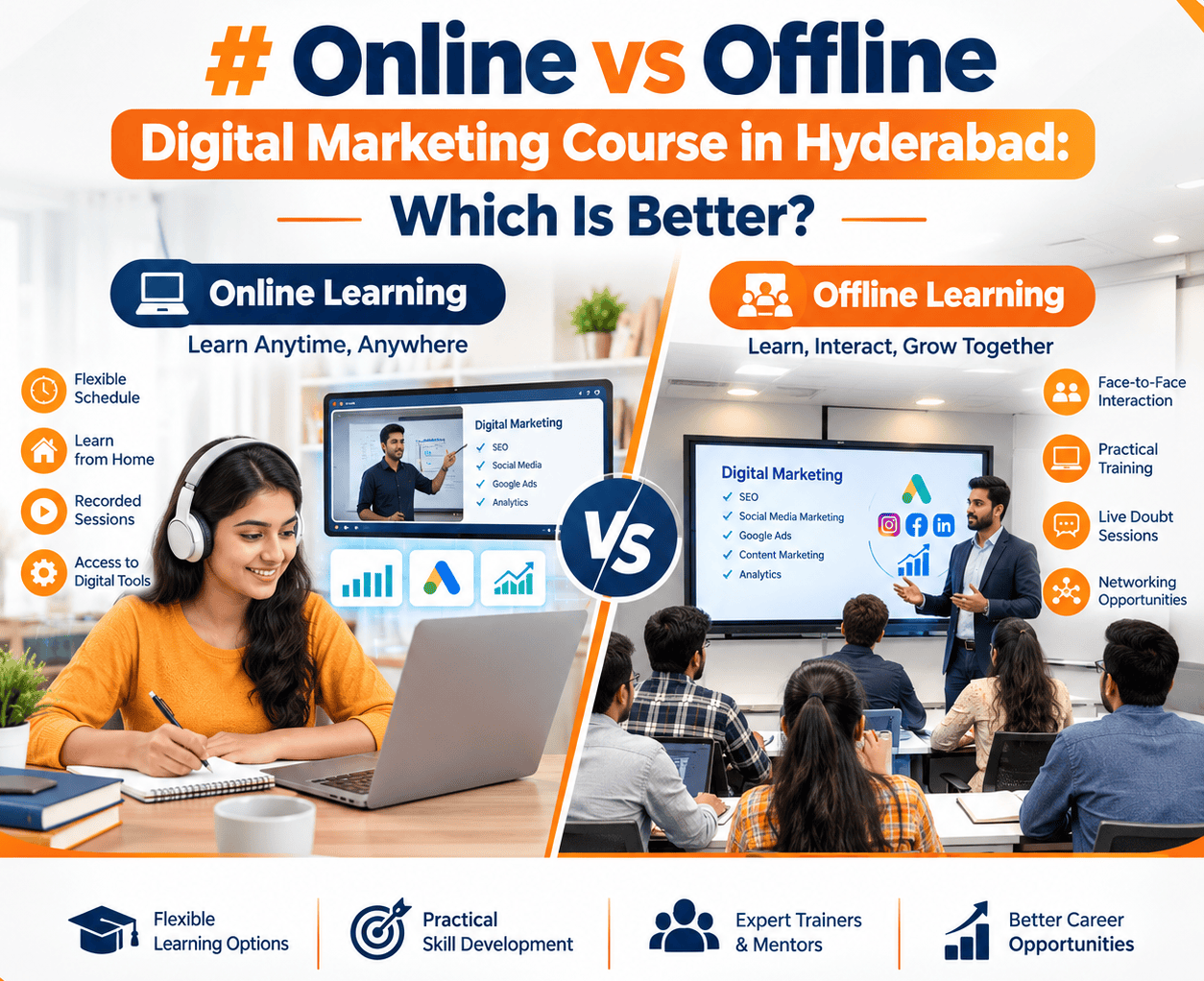
The better choice in the online vs offline digital marketing course debate is the one that gives you live trainer feedback and real campaign practice, and for most Hyderabad beginners that means offline. A live online batch works well if you already have a fixed study routine or cannot travel. Recorded-only online courses rarely build job-ready skills.
Fees, trainer profile and batch size should be checked in writing before you pay, whichever format you choose.
What is the difference between an online and an offline digital marketing course?
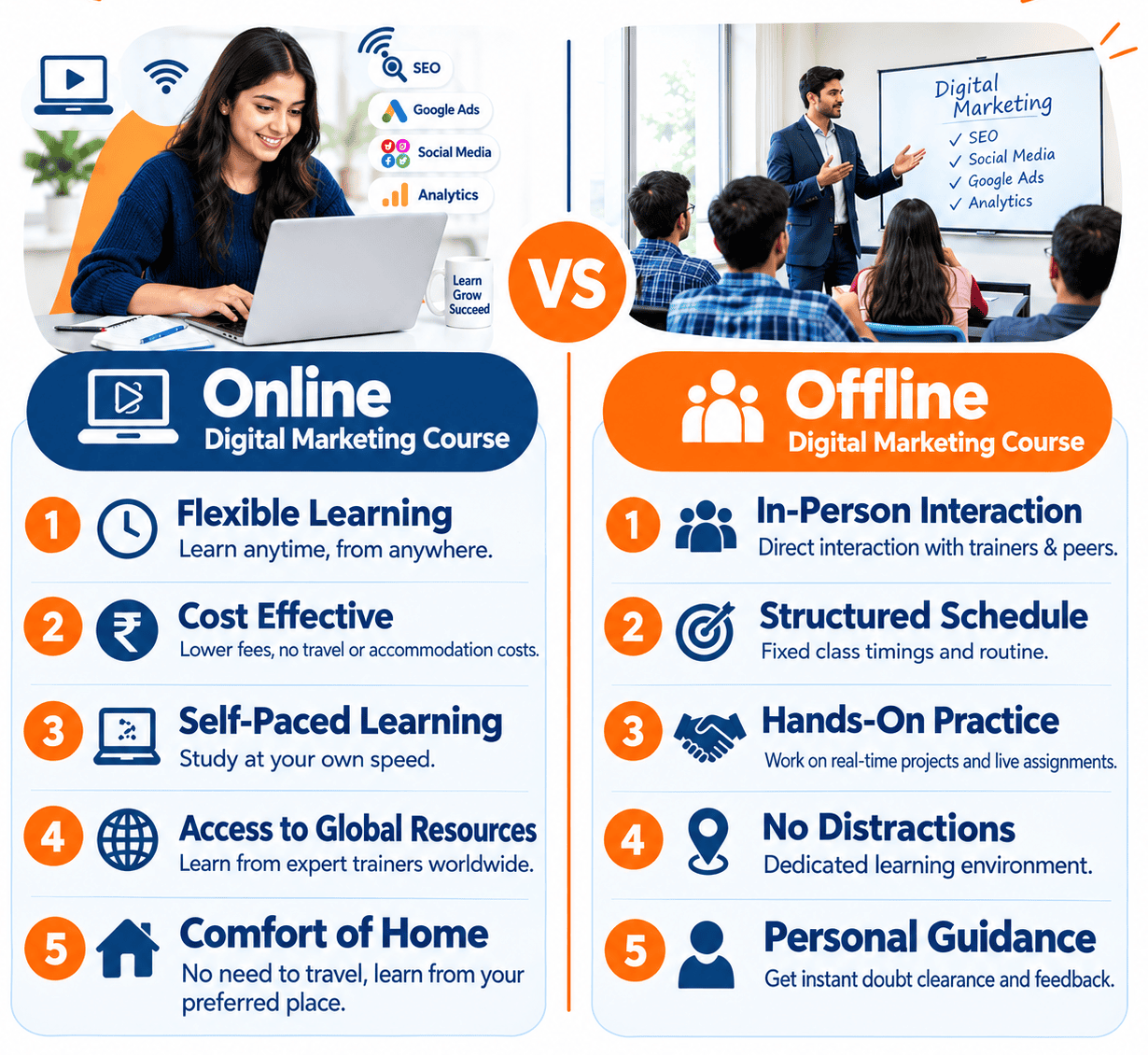
An offline digital marketing course is taught in person at a physical institute, while an online digital marketing course is taught over the internet, either live at fixed times or through pre-recorded videos. The real difference is not the screen. It is how much live feedback, accountability and project practice each format delivers.
At Impact Digital Marketing Institute, the first question we ask a new enquirer is not “online or offline?” It is “how do you learn best when nobody is watching?” Format decides how often you get corrected, and correction is what turns watching into skill.
A live online course follows a fixed timetable with an instructor answering questions in real time, while a recorded course lets you watch videos whenever you like with little trainer contact. A live online course and a recorded course are different products, even though both are sold as online. Our guide to classroom vs recorded courses explains that split in more detail.
Online and offline courses differ in three main ways: how fast you get feedback, how much accountability the format creates, and how flexible your schedule can be. The table compares both formats on the factors Hyderabad learners ask about most.
| Factor | Offline course | Online course |
|---|---|---|
| Trainer feedback | Immediate; the trainer sees your screen and work | Immediate in live batches; delayed in recorded courses |
| Accountability | High, because place and time are fixed | Depends on you; sessions are easy to skip |
| Hands-on tool practice | Easy to guide in the same room | Works through screen sharing; needs stable internet |
| Peer learning | Natural talk before and after class | Possible in small groups; weaker in large batches |
| Schedule flexibility | Low; fixed timetable and commute | Higher; evening and weekend batches are common |
| Travel time | Daily commute across the city | None |
| Best suited to | Freshers and first-time learners | Working professionals and out-of-city learners |
Choose offline when you need structure and face-to-face guidance from day one. Choose a live online batch when commute time or working hours make classroom attendance unrealistic. Avoid recorded-only courses if your goal is a job-ready skill set.
Who should choose an online digital marketing course, and who should choose offline?
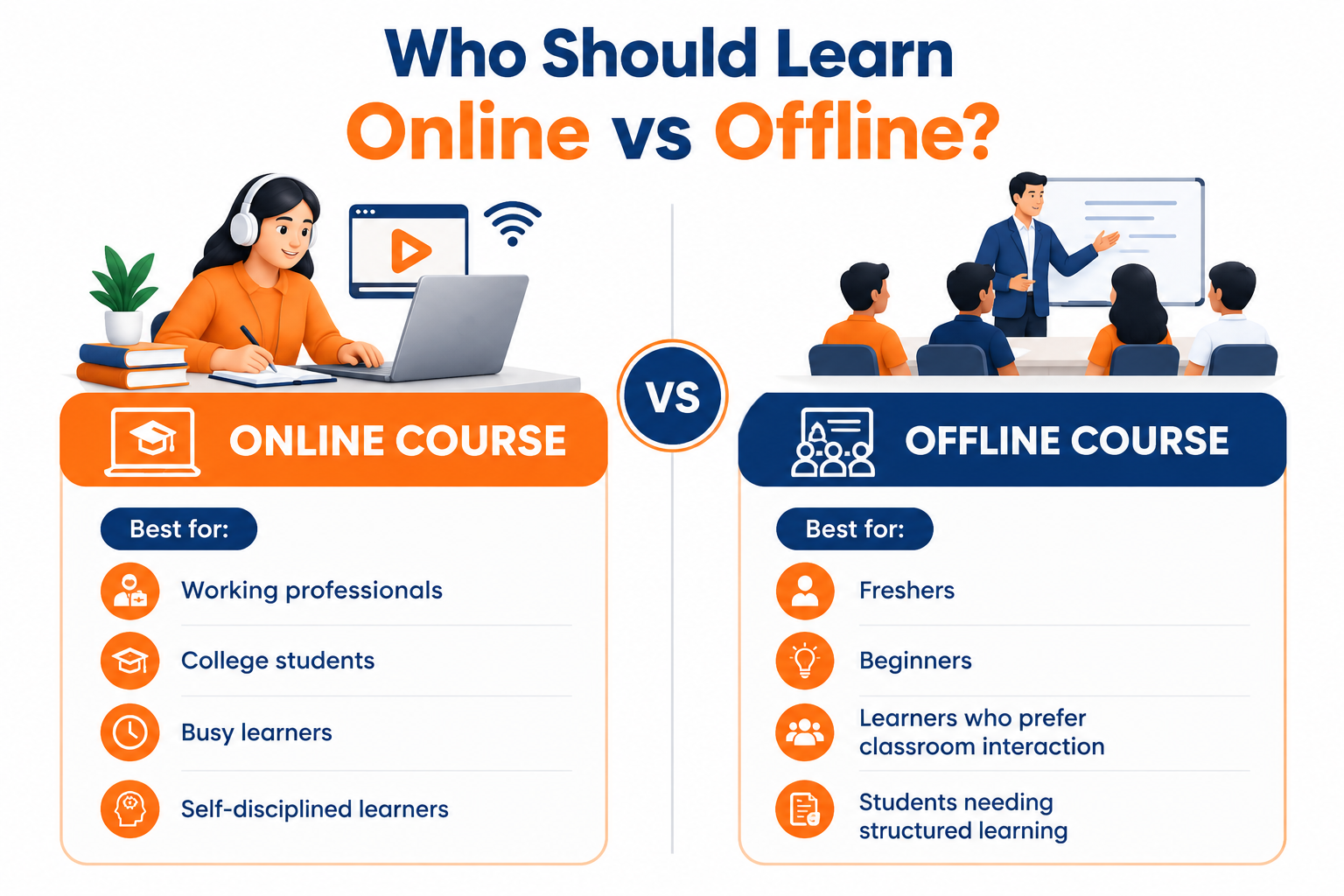
Freshers and first-time learners should usually choose offline, because fixed routines and in-person correction prevent early confusion. Working professionals, learners outside Hyderabad and self-disciplined students can choose a live online batch. Neither format helps if you cannot protect study time each week.
The pattern shows up clearly in practice. In our Impact Digital Marketing Institute batches, learners who come straight from college tend to ask more questions when the trainer is in the room. Working professionals tend to attend more consistently when sessions fit their evenings.
If you have finished an online course before, you can probably handle live online learning; if you have abandoned two, choose a room with a timetable. Your own history is a better guide than any general rule.
The decision guide below maps common reader situations to a recommendation.
| If you are | Recommendation | Reason |
|---|---|---|
| A fresher with no marketing background | Offline | A trainer can spot confusion on your face and fix it the same day. |
| A working professional with fixed office hours | Live online | Evening or weekend batches save commute hours, if you protect the slot. |
| Living outside Hyderabad or abroad | Live online | An interactive trainer matters more than the city you sit in. |
| A learner who has dropped online courses before | Offline | A fixed room removes the daily decision to skip. |
| A business owner learning for your own brand | Either | Work on your own live accounts; the format is secondary. |
| Choosing a recorded-only course to save money | Think twice | Recordings build knowledge, but nobody reviews your work. |
| Facing an offline commute of over an hour each way | Think twice | Travel fatigue causes missed classes; a live online batch may suit you better. |
Recommendations assume a live, trainer-led format; recorded-only courses are covered in the next section.
Do online digital marketing courses give real practical experience?
Yes, but only when the online course is live and project-based. Practical experience means doing real tasks, such as setting up a Google Ads campaign, auditing a website or planning a month of content, and being corrected by a trainer. A course that only plays videos teaches terms, not skills.
The quickest test is to ask what you will have built by week four. If the honest answer is “a certificate” rather than “a live campaign or a working website”, the course design is the problem, not the format. Our article on why live projects matter in digital marketing training explains what to look for.
Free videos still help as a supplement. YouTube learning is not enough for digital marketing on its own, because a video cannot review your account or tell you why an ad was rejected.
Buying a recorded-only course because it is the cheapest option. The price is visible on day one, while the missing feedback only shows up when you get stuck on a real campaign. Ask for a live demo session and a sample project brief before paying.
In our batches, the students who struggle online are rarely the ones who lack ability. They are the ones who never share their screen, so mistakes stay hidden until the project review. At Pixel Ranks Media Agency, junior team members who show half-finished work early improve faster than those who wait to submit something perfect. — Rakesh Bandari, Impact Digital Marketing Institute
Before You Learn Digital Marketing, Check Your Career Fit
Format matters less if the career is not right for you. The assessment takes about 3 minutes and gives you a report right away.
Is an offline digital marketing course in Hyderabad worth the daily commute?
An offline digital marketing course in Hyderabad is worth the commute when the trainer is experienced, the batch is small and the sessions are hands-on. If travel takes more than two hours a day for an average batch, a live online course is the smarter choice. Distance is a real cost, not a minor detail.
Cross-city traffic can turn a two-hour class into a four-hour day. Tired learners skip sessions, and skipped sessions break the sequence from keyword research to ads to analytics. A shorter commute usually predicts attendance better than a bigger institute name.
Batch size matters as much as location. In a large offline batch, quiet learners can sit through months without a trainer looking at their work. Ask how many students share one trainer and whether the trainer reviews individual accounts.
The grid below shows where each format wins and where it fails.
Where offline wins
- Doubts get cleared at your desk
- Fixed timetable builds a habit
- Classmates to practise with
- Trainer sees your screen instantly
Where offline fails
- Commute eats study time
- Large batches hide quiet learners
- Fixed timings clash with jobs
- Limited to institutes you can reach
Where live online wins
- No commute, any city
- Evening and weekend batches
- Replays, if the institute records sessions
- Fits a full-time job
Where live online fails
- Sessions are easy to skip
- Weak internet breaks the flow
- Quiet students rarely speak up
- Fewer informal chats with classmates
Can you combine online and offline digital marketing learning?
Yes. A hybrid digital marketing course combines in-person classes with live online sessions, so you attend the classroom when you can and join online when you cannot. Hybrid works best when the same trainer and the same projects run across both modes, not two separate courses.
Hybrid only works when both modes teach the same syllabus and the same project. Two disconnected formats leave gaps, especially around live tool practice such as Google Ads and Meta Ads Manager.
A 27-year-old commerce graduate working in Kukatpally attends classroom sessions on Saturdays for hands-on ad account practice. On weekday evenings, she joins live online sessions to review the week’s campaign. Both modes follow one project brief, so nothing she builds gets lost between formats.
Language adds another layer. Impact Digital Marketing Institute trains in Telugu, English and Hindi, and a trainer you follow fully matters more than any format label. Learners who think in Telugu can start with our digital marketing course in Telugu.
A hybrid course is a benefit only when the same trainer follows the same projects across both modes.
How do you check a digital marketing course before paying, online or offline?
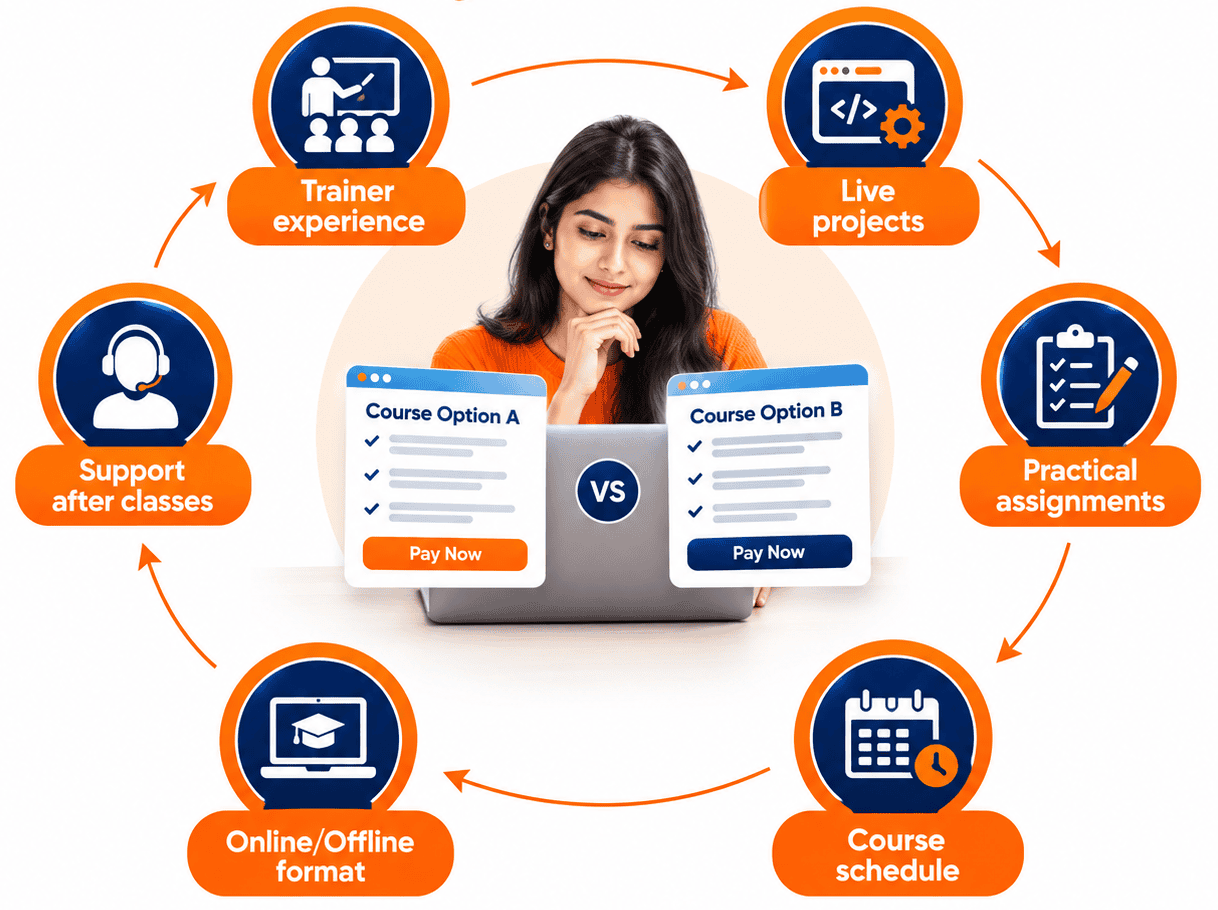
Check five things before you pay: who teaches, whether classes are live, what projects you will build, how big the batch is, and what the written fee and refund terms say. Ask for a demo class in the same format you will join. A demo class is a trial session you attend before committing.
Start with the trainer. Search the trainer’s name on LinkedIn and look for real campaign or agency work, not just a teaching title.
Then check public reputation. For any company that claims to hire from its course, read candidate and employee reviews on Glassdoor India before trusting the claim.
Our article on demo class vs full course shows what to test in a trial session. If several options are on your list, use our guide to compare digital marketing institutes in Hyderabad and carry the questions to ask before joining any course into every demo.
A guaranteed job promise is not a quality signal; written fees, a named trainer and a live demo are. To see how we answer these checks ourselves, read why Impact Digital Marketing Institute is a strong option for digital marketing learners.
Pick the course with live trainer feedback and real projects; for most Hyderabad beginners that is offline, and for working professionals it is a live online batch.
- The best online vs offline digital marketing course in Hyderabad is the one with live trainer feedback and real projects.
- Beginners usually do better offline, while working professionals and out-of-city learners often do well in a live online batch.
- Attend a demo class and get fees, batch size and refund terms in writing before you pay. Impact Digital Marketing Institute encourages this for every learner.
Live online, classroom and recorded courses are three different choices
Do not compare every online course with a classroom course as if they offer the same support. A live online batch includes interaction with a trainer; a recorded course may rely mainly on independent study. Either format can be useful when the learning process fits the student.
Compare these practical differences
- Feedback: who reviews your assignments, how quickly you can ask questions, and whether feedback explains the correction.
- Accountability: attendance, practice deadlines and support when you fall behind.
- Access: travel time for classroom learning, and internet, device and study-space needs for online learning.
- Practice: the work you will complete, tool access and how the portfolio is assessed.
- Flexibility: recordings, missed-session support and the period for which access is available.
Recorded lessons can help with revision or a focused skill, especially when you already have a routine. Beginners who need guidance should check the support that accompanies the videos. Classroom attendance alone also does not guarantee useful practice or a job.
Test the format before deciding
Attend a demo in the format you expect to use. For live online learning, try asking a question and following the practical work on your own device. For classroom learning, account for the commute and check the actual location. Choose the format you can participate in consistently, then verify the course details and support in writing.
Online vs offline digital marketing course: frequently asked questions
Is an online or offline digital marketing course better in Hyderabad?
Short answer: Offline suits most beginners, while a live online batch suits working professionals and learners outside the city.
Quality depends on live trainer feedback, small batches and real projects. A recorded-only course in either format rarely prepares you for a job, so check the teaching method before the format.
Can I learn digital marketing online without joining a course?
Short answer: Yes, you can learn the basics free online, but progress is slower without feedback.
Free resources explain concepts, yet nobody reviews your campaigns or fixes your mistakes. Many learners stall at the practical stage. A live trainer or mentor shortens that gap, especially for paid ads, where small errors waste real money.
Do employers care whether my course was online or offline?
Short answer: Employers care about your skills and portfolio, not the delivery format.
A hiring manager will ask you to explain a campaign you ran or audit a page. Live projects, a working portfolio and clear communication matter far more than whether you attended in a classroom or on a screen.
How long does a digital marketing course take?
Short answer: Most beginner courses take three to six months in either format.
Length depends on class hours per week and project depth. A shorter course can suit professionals with related experience, while freshers often need more practice time. Compare the hours of live sessions, not only the number of months.
Is a recorded digital marketing course enough to get a job?
Short answer: Rarely, because recorded courses teach concepts but not corrected, hands-on practice.
Recordings work as revision material beside live sessions. Alone, they leave you without feedback on real campaigns, which is what interviewers test. If budget forces a recorded option, add a mentor or a live project to cover the gap.
Can I switch from online to offline after joining?
Short answer: Only if the institute allows it in writing, so ask before paying.
Some institutes run separate batches for each format and do not let students move between them. Confirm switching rules, batch timings and any extra fee in your enrolment paperwork, so a schedule change does not cost you the course.
What should I ask for in a demo class?
Short answer: Ask the trainer to show a real campaign or audit and answer your questions live.
Watch how the trainer handles a question they did not prepare for. Check the batch size, tool access and project examples. A good demo shows teaching quality; a weak one only repeats a sales pitch.
- An online digital marketing course teaches over the internet, while an offline course is taught in person at a physical institute in Hyderabad.
- Live trainer feedback and project work decide course quality more than the format, so recorded-only digital marketing courses rarely build job-ready skills.
- Beginners usually do better offline, while working professionals and learners outside Hyderabad often do better in a live online digital marketing batch.
- Before paying, attend a demo class in the format you will join and check the trainer, batch size, projects and refund terms in writing.

Rakesh Bandari
Founder & Lead Trainer, Impact Digital Marketing Institute
6+ years of hands-on digital marketing experience · Pixel Ranks Media Agency
Rakesh Bandari, known as Rakesh Ranks, is the founder and lead trainer at Impact Digital Marketing Institute. With over 6 years of hands-on experience in digital marketing, Rakesh has trained students across India, helping freshers, working professionals, and business owners build real careers in the digital space. He specialises in SEO, Google Ads, Meta Ads, Social Media Marketing, Content Strategy, and AI-powered marketing workflows. Impact Digital Marketing Institute maintains a strong placement track record, with training available in Telugu, English, and Hindi — making it one of the most accessible and practical digital marketing institutes for learners across India.
Find Out If Digital Marketing Matches Your Strengths
Answer a few simple questions in about 3 minutes and get your report right away. It is free and needs no payment.
Get My Career Report