
The syllabus for digital marketing courses in Hyderabad typically covers eleven areas: foundations, website basics, SEO, content, social media, Google Ads, Meta Ads, analytics, automation, AI tools and live projects. A good institute teaches these in a deliberate order and attaches a practical task to every module. A longer topic list does not mean a better course.
What is the syllabus for digital marketing courses in Hyderabad?
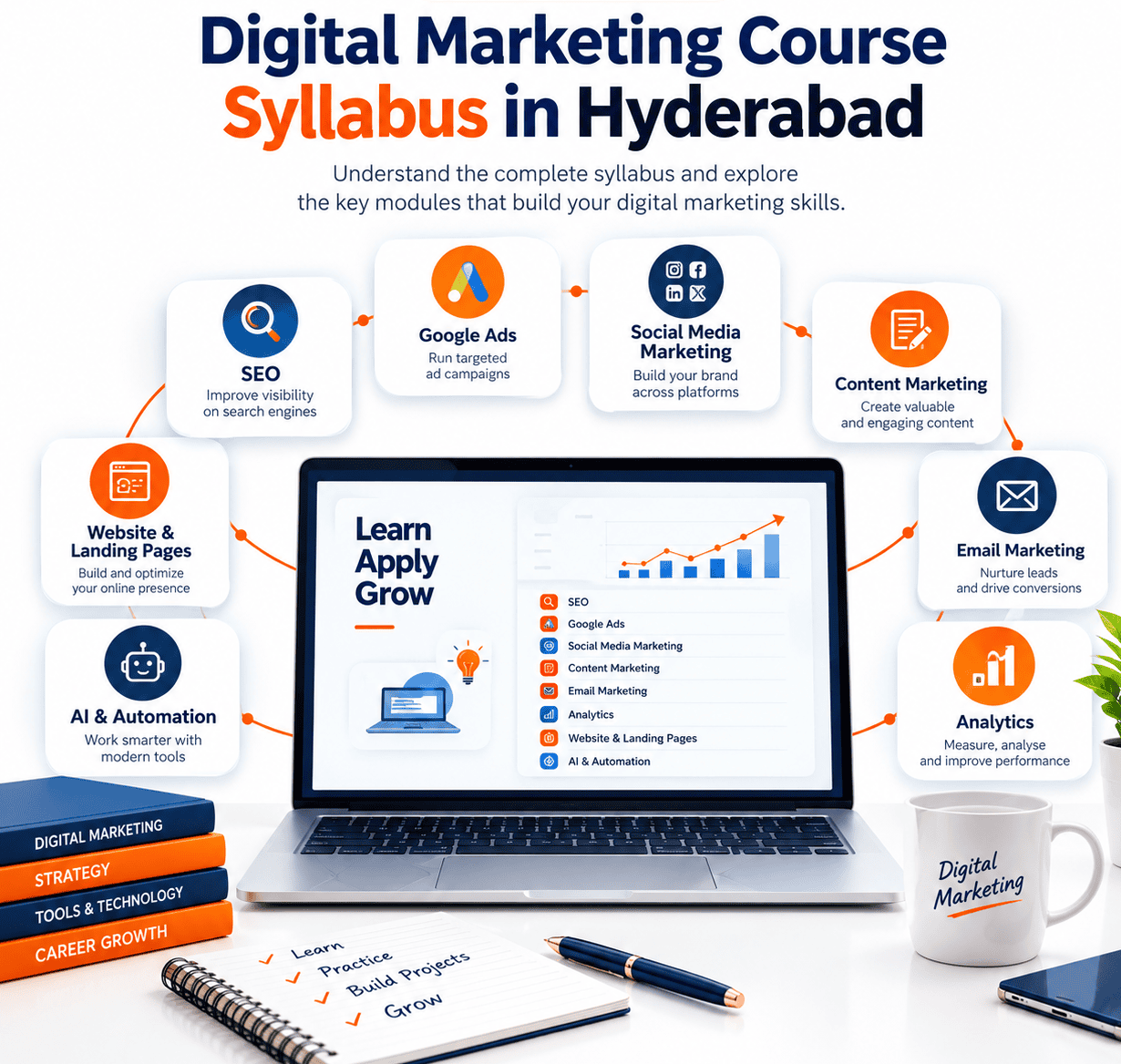
A digital marketing course syllabus is the written plan of modules, tools and practical assignments that an institute teaches across a batch. In Hyderabad, a complete syllabus covers search, social media, paid ads, content, analytics, automation and AI tools, usually over three to six months. Each module should end with a task you can show to an employer or client.
Hyderabad learners compare syllabi because the city has a wide mix of IT companies, startups, agencies and local businesses that all hire marketers. Each of those employers asks for slightly different skills, so the syllabus you choose shapes the roles you can apply for. If the field is new to you, this beginner guide on what digital marketing is explains the basics first.
At Impact Digital Marketing Institute, lead trainer Rakesh Bandari publishes the full teaching plan on the digital marketing course syllabus page for Hyderabad. Learners can read module details before they decide.
Most course brochures list tools, not tasks. A line that says “Google Ads” tells you nothing, while “build and optimise a search campaign in a practice account” tells you exactly what you will do. Always read a syllabus at task level.
Which modules does a complete digital marketing syllabus in Hyderabad cover?
A complete digital marketing syllabus covers eleven modules, from foundations to live projects. Each module should name the tools used and the output produced. The table below shows what to expect from each one and the proof of learning that should come with it.
| Module | What you learn | Hands-on output |
|---|---|---|
| Digital marketing foundations | Channels, funnel stages, buyer journey, basic metrics | A one-page channel plan for a sample business |
| Website and WordPress basics | Domains, hosting, WordPress setup, landing page structure, Rank Math | A live practice website with one landing page |
| SEO | Keyword research, on-page SEO, technical checks, link building, local SEO, Search Console | A keyword map and three optimised pages |
| Content marketing and copywriting | Blog writing, headlines, content calendars, email copy | A one-month content calendar with drafts |
| Social media marketing | Instagram, LinkedIn, YouTube and Facebook content, community handling | A posting plan and sample posts for two platforms |
| Google Ads | Search, display and YouTube campaigns, bidding, conversion tracking | A search campaign built and optimised in a practice account |
| Meta Ads | Campaign structure, audiences, creatives, pixel setup, retargeting | A lead-generation campaign with tested creatives |
| Analytics and reporting | GA4, Google Tag Manager, UTM tags, dashboards | A monthly report linking spend to outcomes |
| Email and WhatsApp marketing | List building, sequences, message templates, basic segmentation | A three-message nurture sequence |
| Automation and AI tools | ChatGPT, Claude, Perplexity, n8n or Zapier, simple workflows | A working automation and a reviewed AI content workflow |
| Live projects and career preparation | Client-style briefs, portfolio building, freelancing basics, interview practice | A portfolio with at least two documented projects |
Use this table as a benchmark: any module with no hands-on output is a warning sign.
Keyword research should use a professional platform such as Semrush alongside Google’s free options, so learners see how search volume and difficulty are measured. The analytics module should use Google Analytics 4, the free platform most employers already run.
Which modules are core?
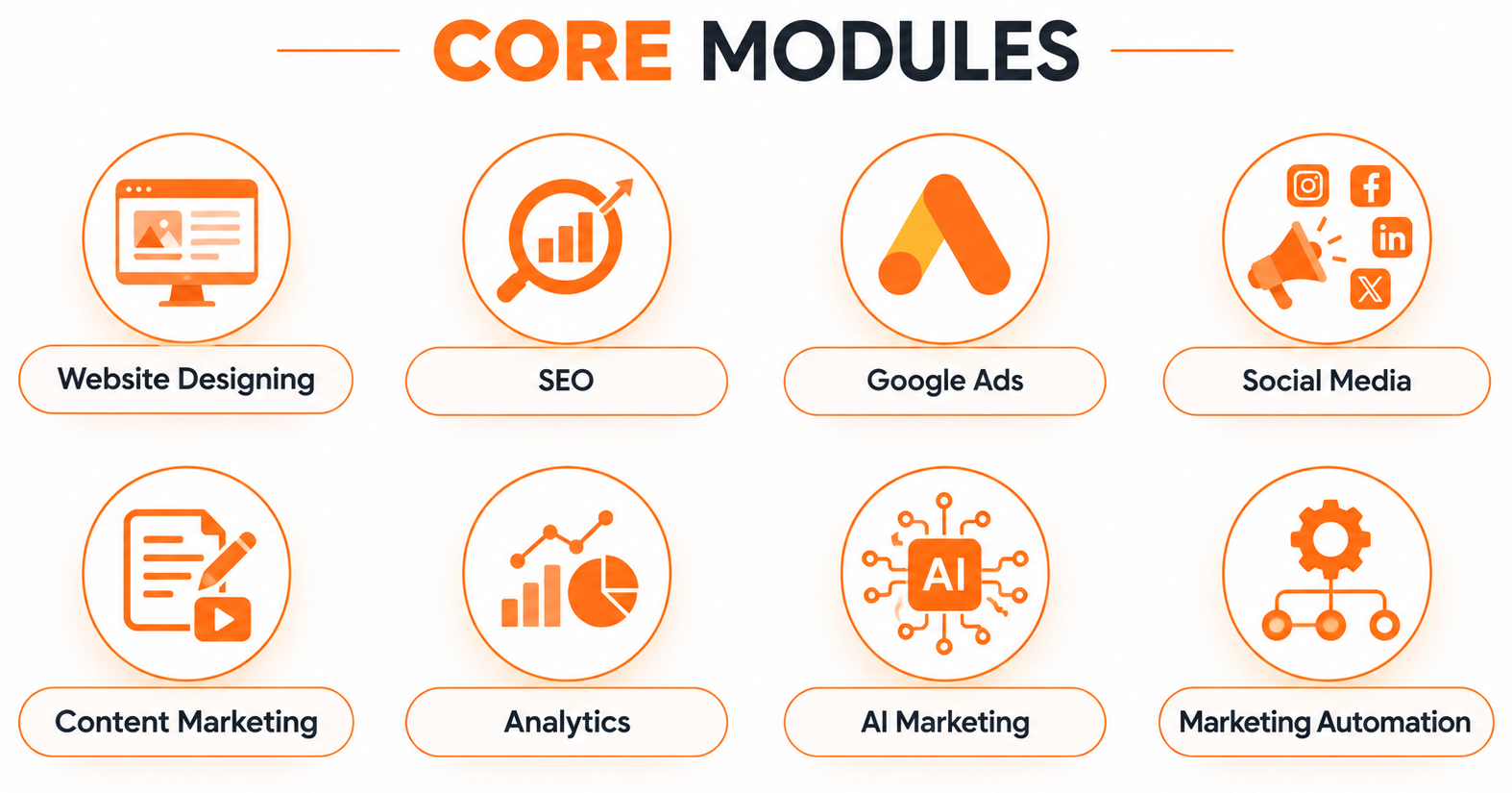
Core modules are SEO, Google Ads, Meta Ads, content and analytics, because nearly every digital marketing job description names at least three of them. At Impact Digital Marketing Institute, each of these modules ends with a practical task rather than a theory test.
Which modules are optional?
Optional modules include video editing, influencer outreach and deeper automation work. These add value once the core five are solid, and they should never replace them. For a wider view of channels, see this explainer on the types of digital marketing.
In our batches, learners who skip the analytics module struggle most in interviews. Employers ask them to explain why a campaign worked, not only how it was built, and only reporting practice prepares that answer.
In what order should the digital marketing syllabus be taught?
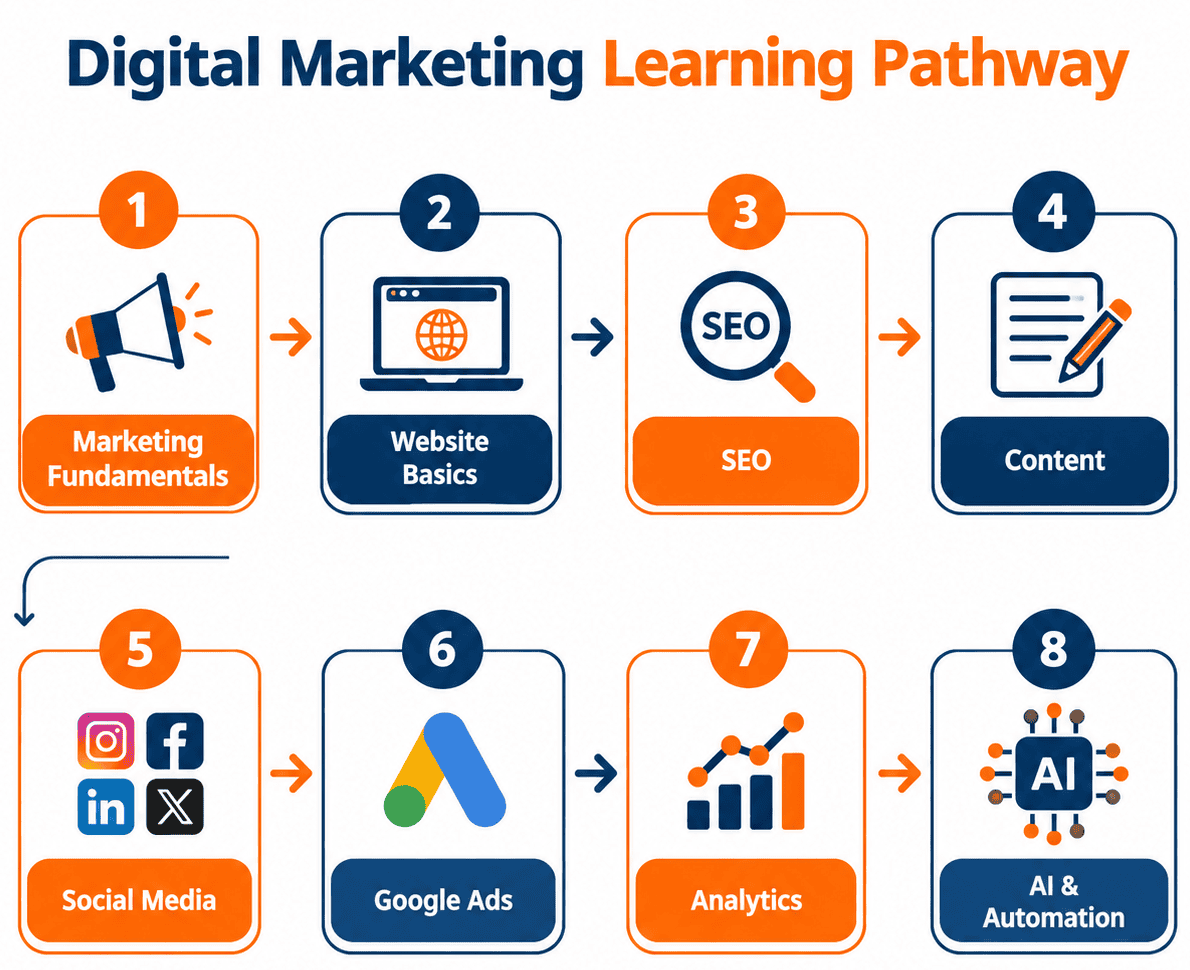
A digital marketing syllabus should be taught in this order: foundations, website basics, SEO and content, social media, paid ads, analytics, automation with AI, and live projects. Organic channels come before paid ads because learners then understand search intent, audiences and landing pages before spending any budget. The steps below show the sequence.
- Learn the funnel and the channels. Awareness, consideration and conversion are the three funnel stages that every later module refers to.
- Build a practice website. A WordPress site gives every later assignment a real home.
- Practise SEO and content together. Keyword research and writing belong side by side because each decides what the other produces.
- Run organic social media. Posting on two platforms teaches audience behaviour before ad spend enters the picture.
- Launch paid campaigns. Google Ads captures demand that already exists, while Meta Ads creates new demand through audience targeting.
- Measure, automate and use AI. GA4 reports, simple workflows and AI-assisted drafting turn one-off tasks into repeatable systems.
- Finish with live projects. Client-style briefs combine every earlier module into portfolio pieces.
At Pixel Ranks Media Agency, we onboard junior marketers in nearly the same order. Juniors who understand the funnel before touching an ad account need far fewer corrections in their first campaigns.
A 27-year-old commerce graduate who follows this order publishes three optimised blog posts on a practice WordPress site during the SEO module. The same posts then become landing content for a small Meta Ads test, and the final analytics report connects both. By the end, the learner holds one site, one ads account history and one report, all linked.
Jumping into paid ads first is the most common sequencing error. It happens because ads feel closest to income. Without keyword, audience and landing page knowledge, budget burns on clicks that never convert, so start with foundations and organic channels.
Which AI tools and automation should a Hyderabad digital marketing syllabus include?
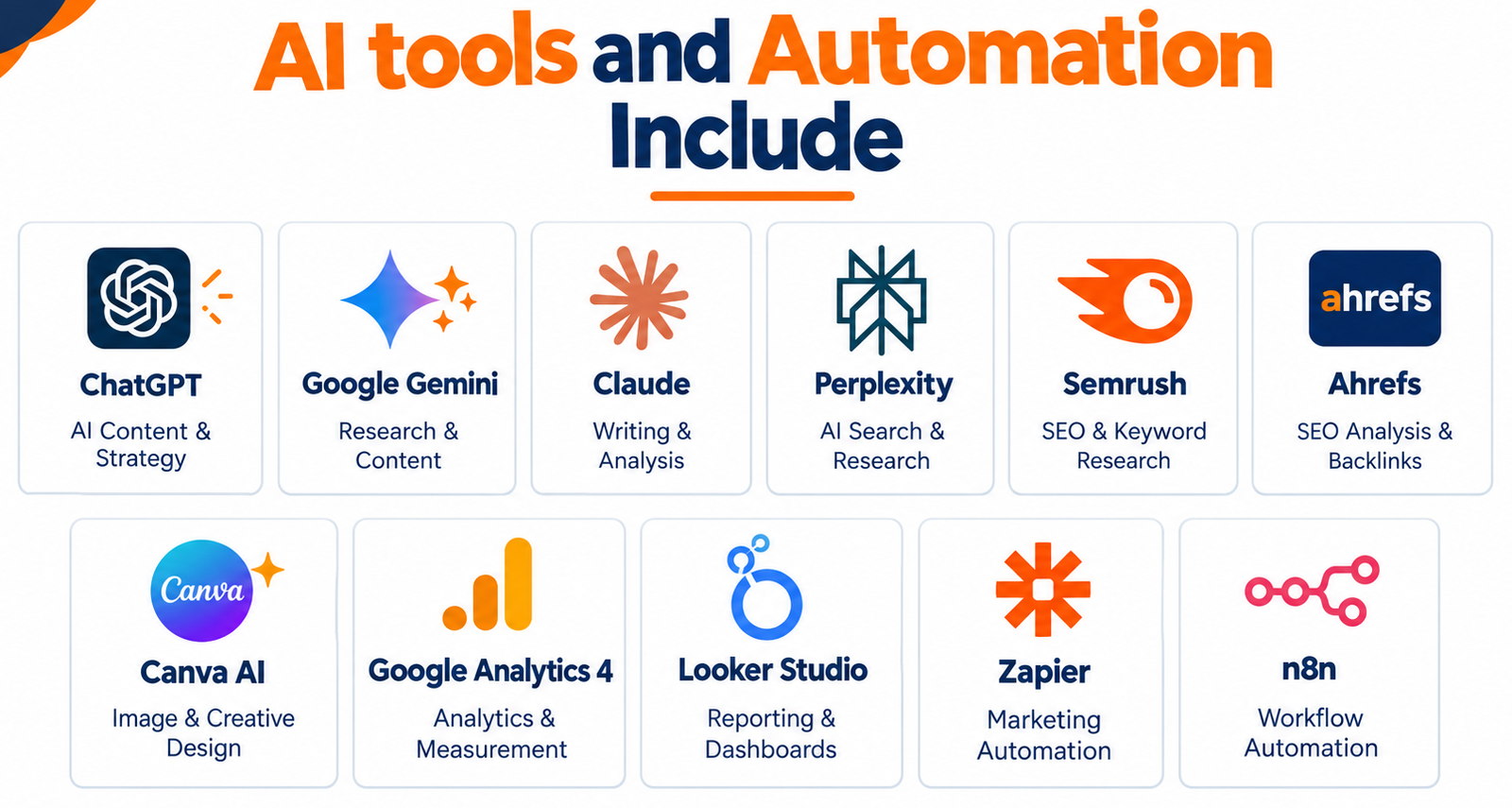
A current Hyderabad digital marketing syllabus should teach AI as a working layer across every module, not as one separate chapter. That means prompting tools such as ChatGPT, Claude and Perplexity for research and drafts, workflow tools such as n8n or Zapier for repeat tasks, and AEO (Answer Engine Optimisation) and GEO (Generative Engine Optimisation) for AI search visibility.
A strong AI section includes four practical skills:
- Writing precise prompts for research, outlines and ad copy variations.
- Reviewing AI output for factual errors, repeated phrasing and missing brand voice.
- Building small automations, such as sending a form lead to a spreadsheet and an email.
- Structuring content so AI answer engines can quote it clearly.
The guides on the role of AI in digital marketing and the best AI tools for digital marketers cover tool choices in depth. The walkthrough on how to do AEO and GEO explains answer-engine optimisation step by step.
Learning three AI tools well beats sampling twenty. At Pixel Ranks Media Agency, AI drafts speed up first versions, but every client deliverable still goes through human review for accuracy and tone. A syllabus that teaches prompting without teaching review leaves a gap that employers notice quickly.
Before You Learn Digital Marketing, Check Your Career Fit
Learning every module only pays off if the career suits you. The free assessment takes about 3 minutes and returns your report right away.
How long does it take to complete a digital marketing course syllabus in Hyderabad?
Most digital marketing courses in Hyderabad run three to six months, and the real duration depends on practice hours rather than topic count. A three-month batch can cover core channels at working depth. A six-month batch adds specialisation, more live projects and portfolio time.
A three-month batch usually compresses foundations, SEO, ads and analytics into focused blocks. A six-month batch spends the extra time on deeper tools and polished projects. The detailed comparison sits in this guide on 3 months versus 6 months digital marketing courses in Hyderabad.
The number of campaigns each learner runs matters more than the number of months. In our batches at Impact Digital Marketing Institute, learners who run several small campaigns in a practice account explain results far more confidently than learners who only watch demonstrations.
Training is available in Telugu, English and Hindi, and the module content does not change with the language. Choosing the language that feels natural therefore costs nothing in coverage.
Does the syllabus matter more than live projects when choosing a digital marketing course?
No. A syllabus shows what an institute intends to teach, while live projects show what learners actually practise. Two Hyderabad institutes can publish identical module lists, yet one has learners run real campaigns and the other only demonstrates slides. Judge a course by the practice built into each module.
The articles on why the syllabus does not decide course quality and why live projects matter in digital marketing training go deeper on this point.
In our batches, the question I hear most often is “does the syllabus include everything?” The stronger predictor of a learner’s confidence is how many live tasks that learner completes. At Pixel Ranks Media Agency, we shortlist junior candidates by asking them to walk us through one campaign they ran, never by asking them to list modules. — Rakesh Bandari, Founder, Impact Digital Marketing Institute
The practical test is simple. Ask to see a past learner’s campaign report, and ask which parts that learner built personally.
How can you check whether a Hyderabad digital marketing syllabus is genuine?
Ask for task-level detail. Every module should list its tools, the assignment you will complete and who reviews it. A genuine syllabus also states batch size, trainer background and what happens when you miss a class. Vague module names with no outputs signal a brochure, not a course.
The guides on how to identify fake digital marketing institutes and questions to ask before joining any course add more checks. Impact Digital Marketing Institute welcomes learners asking every one of them.
- The syllabus for digital marketing courses in Hyderabad should list modules, tools and a hands-on task for every topic.
- Teaching order matters: foundations and organic channels come before paid ads, and AI tools run through every module.
- Practice hours and live projects say more about a course than the length of its topic list.
What does the Career Assessment tell you before you choose a syllabus?
The Impact Digital Marketing Career Assessment™ is a free, three-minute questionnaire that checks whether digital marketing suits your strengths, learning readiness and goals. It returns a report right away, and no payment is needed. Its only purpose is to help you decide before you spend time or money on any course.
Take The Career AssessmentFrequently asked questions about the digital marketing syllabus in Hyderabad
What topics are included in a digital marketing course syllabus?
Short answer: A full syllabus includes foundations, website basics, SEO, content, social media, Google Ads, Meta Ads, analytics, automation, AI tools and live projects.
Strong syllabi attach a practical assignment to each topic, so learners finish with campaigns, reports and a portfolio rather than notes alone.
How long is a digital marketing course in Hyderabad?
Short answer: Most digital marketing courses in Hyderabad run between three and six months.
Shorter batches cover core channels at working depth, while longer batches add specialisation, more live projects and portfolio time. Weekday and weekend schedules change the calendar length but not the content. Ask how many practice hours each schedule includes.
Do I need a technical background to follow a digital marketing syllabus?
Short answer: No technical background is needed; basic English, a laptop and steady practice are enough to begin.
Modules like analytics and automation feel technical at first, so good trainers teach them step by step with screen-by-screen tasks. Commerce, arts and engineering graduates all start from the same foundation module.
Is AI part of a digital marketing syllabus in Hyderabad?
Short answer: Yes, a current syllabus should teach AI tools such as ChatGPT, Claude and Perplexity inside each module.
The goal is faster research and first drafts, followed by human review for facts and brand voice. Ask whether the course also covers optimising content for AI answer engines.
Which module should I learn first in digital marketing?
Short answer: Start with digital marketing foundations, then website basics, because every other channel depends on the funnel and a landing page.
Learners who begin with paid ads before these basics often waste budget on clicks that never convert. SEO and content come next, and ads follow once audiences and pages are clear.
Can I learn digital marketing in Telugu in Hyderabad?
Short answer: Yes, Impact Digital Marketing Institute trains in Telugu, English and Hindi.
Learning in a comfortable language helps ideas like the funnel and attribution settle faster. Tool names and platform screens stay in English, so ask any institute which language is used in practical sessions.
How do I know if a digital marketing syllabus is outdated?
Short answer: A syllabus is outdated if it teaches only classic channels and ignores GA4, AI tools and answer-engine optimisation.
Other warning signs include screenshots from retired platform versions and no mention of conversion tracking. Ask the institute when the syllabus was last revised and what changed.
- A digital marketing syllabus in Hyderabad should list modules, tools and a hands-on assignment for every topic.
- A complete syllabus covers foundations, website basics, SEO, content, social media, Google Ads, Meta Ads, analytics, automation, AI tools and live projects.
- Most Hyderabad digital marketing courses run three to six months, and practice hours matter more than the number of topics listed.
- Impact Digital Marketing Institute offers a free three-minute Career Assessment that helps learners check career fit before choosing a syllabus.
Related articles

Rakesh Bandari
Founder and Lead Trainer, Impact Digital Marketing Institute
6+ years of hands-on digital marketing experience
Rakesh Bandari, known as Rakesh Ranks, is the founder and lead trainer at Impact Digital Marketing Institute. With over 6 years of hands-on experience in digital marketing, Rakesh has trained students across India, helping freshers, working professionals, and business owners build real careers in the digital space. He specialises in SEO, Google Ads, Meta Ads, Social Media Marketing, Content Strategy, and AI-powered marketing workflows. Impact Digital Marketing Institute maintains a strong placement track record, with training available in Telugu, English, and Hindi — making it one of the most accessible and practical digital marketing institutes for learners across India.
Find Out If Digital Marketing Matches Your Strengths
Answer a few simple questions in about 3 minutes and get your report right away. It is free, and no payment is needed.
Start My Assessment